

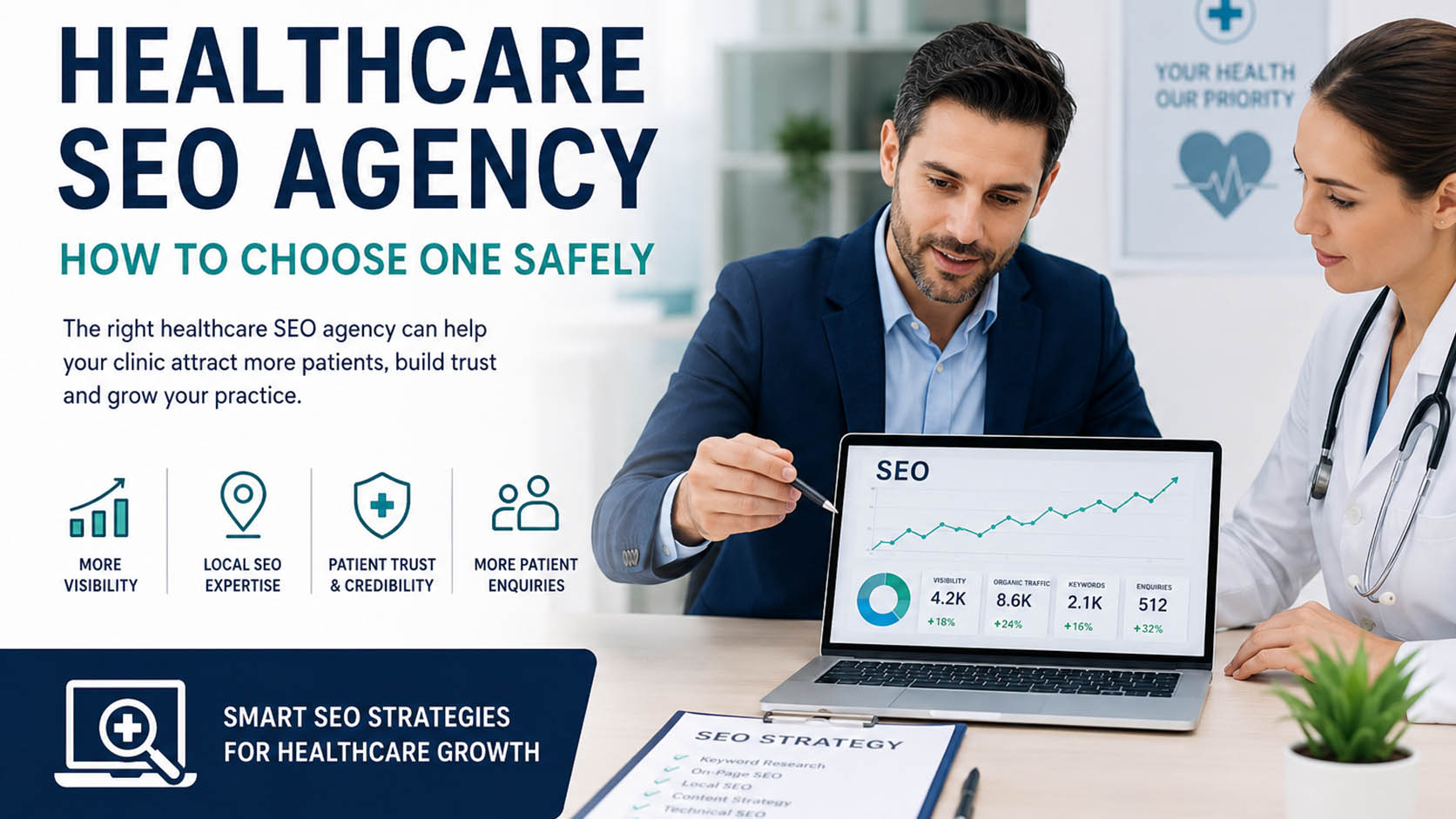
Knowing how to choose a healthcare SEO agency can protect your organisation from unsuitable strategies, unclear reporting and content that fails to reflect the needs of patients.
Healthcare search is built around trust. Patients are not simply comparing prices or looking for the nearest business. They want clear information, credible professionals, relevant experience and confidence that they are choosing an appropriate provider.
Healthcare SEO must therefore do more than increase rankings and website traffic. It should help clinics, doctors, dentists, therapists and other healthcare providers reach suitable patients while supporting their decision to enquire or book.
Before appointing an agency, you should understand what specialist healthcare SEO involves, which questions to ask, what evidence to request and which warning signs to avoid.
Why Choosing a Healthcare SEO Agency Requires Care
Patients often search while feeling concerned or uncertain about a medical issue. They may visit several websites before choosing a clinic or practitioner.
During that process, they are likely to ask:
- Does this provider offer the treatment I need?
- Is the doctor or practitioner appropriately qualified?
- Is the clinic located near me?
- What will happen during the appointment?
- Can I trust the information on this website?
- Are there genuine reviews from other patients?
- How can I book an appointment?
An effective healthcare search strategy must address rankings, patient intent, local visibility, content quality, professional trust and conversion.
A general SEO provider may focus on keywords, blogs and backlinks. A healthcare SEO agency should also understand how patients search, what information they require and what gives them confidence to contact a provider.
The agency does not necessarily need to work exclusively in healthcare. However, it should be able to demonstrate that its proposed strategy reflects the responsibilities and complexities of healthcare search.
What Does a Healthcare SEO Agency Do?
A healthcare SEO agency helps medical organisations improve their organic search visibility and generate relevant patient enquiries.
It may work with:
- Private clinics
- Doctors and consultants
- Dentists
- Physiotherapists
- Therapists
- Dermatologists
- Mental health providers
- Aesthetic clinics
- Specialist treatment centres
- Multi-location healthcare organisations
The work should begin with an assessment of the organisation’s services, locations, website, competitors and current search performance.
A complete strategy may then include:
- Patient-focused keyword research
- Treatment and service page optimisation
- Technical SEO
- Local SEO
- Google Business Profile optimisation
- Practitioner profile improvements
- Medical content planning
- Internal linking
- Website authority development
- Enquiry and appointment tracking
The exact combination will depend on the organisation, its website and the patients it wants to reach.
What Should You Look for in a Healthcare SEO Agency?
The following capabilities can help you determine whether an agency understands healthcare search or is simply applying a generic SEO package.
1. Patient-focused keyword research
Healthcare keyword research should not be based on search volume alone.
The agency must understand the intention behind each search and assign it to the most appropriate page.
Patient searches can usually be divided into several categories.
Appointment-focused searches
These indicate that someone may be close to booking:
- Private GP appointment
- Emergency dentist near me
- Physiotherapy clinic in London
- Dermatologist appointment
- Private dental implants clinic
Informational searches
These are commonly used earlier in the patient journey:
- What causes persistent tooth pain?
- How long does acne treatment take?
- What happens during a private GP appointment?
- What are the symptoms of sciatica?
- Invisalign or traditional braces?
Local searches
These combine a service or practitioner with a place:
- Private doctor in Birmingham
- Dentist in Manchester
- Skin clinic in London
- Physiotherapist in Leeds
Commercial keywords should normally be assigned to treatment or service pages. Informational searches may be addressed through articles, guides or FAQs. Location-based searches may require strong local pages and an accurate Google Business Profile.
If every keyword is treated in the same way, the website can become unfocused and multiple pages may begin competing for the same search intent.
2. Strong treatment and service pages
Treatment and service pages are usually responsible for generating enquiries.
A clinic can publish dozens of articles, but those articles will not compensate for weak commercial pages.
A properly developed service page should explain:
- What the service or treatment involves
- Who may be suitable for it
- Which concerns or conditions it addresses
- What patients can expect
- Who provides the treatment
- Relevant qualifications or experience
- Where the treatment is available
- Common patient questions
- Pricing guidance where appropriate
- How to enquire or book
The content should be genuinely helpful rather than written only to include keywords.
Providers operating in specialist areas should ask whether the agency understands how patients search across related treatments and stages of care. This is especially important when planning fertility clinic SEO services for clinics offering multiple treatments, specialists or locations.
Ask the agency which existing pages it would improve before recommending the creation of additional content.
3. Local healthcare SEO knowledge
Most clinics and practitioners depend on patients from a defined geographical area.
The agency should understand how to improve visibility in traditional organic results and local map results.
Local healthcare SEO may include:
- Google Business Profile optimisation
- Accurate clinic names, addresses and telephone numbers
- Appropriate primary and secondary business categories
- Location-specific service pages
- Review generation and management
- Local citation checks
- Map visibility analysis
- Local structured data
- Location-based internal linking
- Multi-location website planning
The proposed approach should reflect how the healthcare organisation actually operates. It should not rely on fabricated locations, misleading profiles or pages for places the organisation does not genuinely serve.
4. A responsible healthcare content process
Healthcare content must be clear, accurate and genuinely useful.
A healthcare content plan may include:
- Treatment guides
- Condition explainers
- Frequently asked questions
- Cost guides
- Appointment preparation information
- Recovery guidance
- Treatment comparisons
- Local patient resources
- Articles supporting important service pages
Every article should have a defined purpose. It might answer a patient question, support a treatment page, strengthen topical relevance or help someone make an informed decision.
Ask the agency:
- Who researches the topics?
- How are factual and medical claims checked?
- Will the content reflect your actual services?
- Can an appropriate practitioner review the content?
- How will articles support treatment and service pages?
- How will the agency avoid repeating existing content?
- How will it prevent different pages from competing with one another?
Publishing generic articles simply to increase the number of indexed pages is unlikely to produce meaningful business results.
5. Technical SEO capabilities
A professional-looking healthcare website can still contain technical problems that restrict its visibility.
A technical review may examine:
- Crawling and indexing
- XML sitemaps
- Page speed
- Mobile usability
- Broken links
- Redirects
- Duplicate content
- Canonical tags
- Structured data
- Internal linking
- Core Web Vitals
- Thin or low-value pages
- Form and appointment tracking
Technical problems should be identified before large amounts of new content are published.
Creating more treatment pages will provide little value if search engines cannot crawl, index or understand them correctly. A medical website SEO audit can identify these priorities before a wider campaign begins.
6. Trust and credibility improvements
Trust is central to healthcare marketing.
Patients want to know who they are contacting and why they should feel confident choosing that provider.
Important trust signals can include:
- Detailed practitioner profiles
- Professional qualifications
- Registration information where relevant
- Clinic addresses and contact details
- Genuine patient reviews
- Clear treatment explanations
- Real photographs
- Transparent appointment processes
- Relevant policies
- Frequently asked questions
- Pricing guidance where appropriate
An agency should recognise that these elements affect both patient confidence and website conversion.
Improving rankings without improving the quality and credibility of the landing page may not result in more enquiries.
7. Enquiry and conversion tracking
SEO performance should not be judged by rankings and traffic alone.
The agency should identify which actions matter to your organisation and ensure they can be measured accurately.
These actions may include:
- Appointment bookings
- Contact form submissions
- Telephone calls
- Booking button clicks
- Email link clicks
- WhatsApp clicks where appropriate
- Visits to confirmation pages
- Organic landing-page conversions
This information can help identify which treatments, locations and pages generate genuine opportunities.
A keyword ranking is useful, but it has limited commercial value if the resulting traffic never becomes an enquiry.
How to Choose a Healthcare SEO Agency Step by Step
Use the following process to compare potential providers consistently.
Step 1: Define what you need from SEO
Before contacting an agency, identify your main objectives.
For example, you may want to:
- Increase bookings for a particular treatment
- Improve visibility for a clinic location
- Strengthen practitioner pages
- Resolve technical indexing problems
- Improve Google Business Profile visibility
- Generate more suitable patient enquiries
- Understand why existing traffic is not converting
Clear objectives make it easier to evaluate whether an agency’s recommendations address your actual needs.
Step 2: Ask for an initial assessment
The agency should review your existing website and search performance before presenting a detailed strategy.
An initial assessment may consider:
- Current organic visibility
- Important treatment pages
- Existing keyword rankings
- Competing pages
- Indexing problems
- Local visibility
- Website structure
- Conversion pathways
- Analytics and tracking
Recommendations made without examining the website or its search data may be based on assumptions.
Step 3: Ask how keywords will be assigned to pages
Ask the agency to explain the difference between informational, local and appointment-focused searches.
For example:
- “What causes tooth pain?” reflects informational intent.
- “Emergency dentist near me” reflects urgent local intent.
- “Private GP appointment” reflects commercial intent.
- “How much do dental implants cost?” may indicate comparison intent.
The agency should be able to explain which type of page should target each search and how it will prevent keyword cannibalisation.
Step 4: Check which pages will be prioritised
Some providers recommend a large blogging schedule before reviewing the pages responsible for generating enquiries.
A more considered approach usually begins by examining:
- Treatment pages
- Service pages
- Practitioner profiles
- Clinic location pages
- Pricing information
- Contact routes
- Frequently asked questions
- Calls to action
Blog content should support these pages rather than attempt to replace them.
Step 5: Review the proposed technical work
Ask what the agency will inspect before starting the campaign.
A credible answer should include areas such as:
- Indexation
- Crawlability
- Mobile usability
- Website speed
- Internal links
- Redirects and canonical tags
- Existing page quality
- Analytics configuration
- Conversion tracking
The agency should also explain which issues are important. Automated audit tools often produce long lists of warnings, but not every warning has the same effect on search performance.
Step 6: Evaluate its understanding of local search
If patients visit a physical location, local SEO should be part of the discussion.
Ask how the agency will approach:
- Google Business Profile optimisation
- Map visibility
- Clinic reviews
- Local landing pages
- Location-specific keywords
- Local citations
- Multiple clinic locations
The agency should connect local visibility with relevant services, real locations and appointment generation.
Step 7: Examine how content will be produced
Healthcare content should not read like generic, mass-produced marketing copy.
Request a clear explanation of the editorial process.
Find out:
- Who selects the topics?
- Who conducts the research?
- How are claims checked?
- Who writes and edits the content?
- Can your practitioners review it?
- How will content reflect your services?
- How will articles support commercial pages?
- How will outdated information be reviewed?
The answers should demonstrate a structured process rather than a promise to publish a fixed number of articles each month.
Step 8: Ask how performance will be reported
A useful report should cover more than the number of articles or links produced.
Monthly reporting may include:
- Organic enquiries
- Calls and form submissions
- Appointment actions
- Keyword movement
- Search visibility
- Indexed pages
- Landing-page performance
- Completed work
- Identified problems
- Priorities for the next month
The agency should be able to explain what changed, why it matters and what happens next.
A Healthcare SEO Agency Evaluation Scorecard
You can use this scorecard when comparing providers. Give each agency a score from zero to two for every area.
| Assessment area | 0 points | 1 point | 2 points |
|---|---|---|---|
| Healthcare understanding | Generic proposal | Some relevant awareness | Clear understanding of patients and services |
| Initial assessment | No meaningful review | Basic automated audit | Website, search data and priorities reviewed |
| Keyword strategy | Keyword list only | Some intent grouping | Keywords mapped to suitable pages |
| Service pages | Blogging prioritised | Basic on-page changes | Treatment and service pages prioritised |
| Local SEO | Not included | General local activity | Clinic-specific local strategy |
| Content process | Generic production | Limited review process | Research, factual review and practitioner input |
| Technical SEO | Tool warnings only | Basic checks | Prioritised technical investigation |
| Trust signals | Not discussed | General conversion advice | Practitioner and clinic trust considered |
| Measurement | Rankings only | Traffic and rankings | Calls, forms, bookings and landing pages |
| Reporting | Activity list | Basic monthly report | Results, context, completed work and next actions |
| Communication | Unclear | Occasional updates | Named contact and agreed communication schedule |
| Ownership | Unclear terms | Partial ownership | Clear ownership of content, data and accounts |
A lower price should not compensate for unclear ownership, unsuitable content or an inability to explain the proposed strategy.
The scorecard is a comparison tool rather than a guarantee of performance. Use it alongside references, proposal details and direct conversations with each provider.
Warning Signs to Avoid
Be cautious if an agency:
- Guarantees immediate first-page rankings
- Uses the same strategy for every clinic
- Does not ask about your treatments or patients
- Recommends blogs before reviewing service pages
- Ignores Google Business Profile optimisation
- Cannot explain patient search intent
- Publishes thin or generic content
- Does not inspect Google Search Console
- Focuses entirely on backlinks
- Avoids discussing technical SEO
- Reports traffic without tracking enquiries
- Cannot explain what work will be completed
- Uses unclear or risky link-building methods
- Refuses to explain account or content ownership
- Cannot identify who will manage your campaign
SEO takes time, but that should not be used as an excuse for vague strategies, unexplained activity or poor communication.
Specialist Healthcare SEO vs General SEO
A general provider may be capable of producing good results, but it must still demonstrate an understanding of healthcare search.
| Area | General SEO approach | Specialist healthcare SEO approach |
|---|---|---|
| Keyword research | Primarily based on volume | Based on patient intent and service relevance |
| Content | General blogging | Treatment, condition and patient-decision content |
| Service pages | Basic optimisation | Detailed, patient-focused pages |
| Local SEO | Standard business optimisation | Clinic, practitioner and treatment visibility |
| Trust | May receive limited attention | Central to content and conversion |
| Tracking | Traffic and rankings | Enquiries, calls and bookings |
| Reporting | SEO activity | Performance connected to patient acquisition |
The label attached to an agency matters less than the quality of its process. However, relevant healthcare experience may reduce the risk of generic or unsuitable recommendations.
How Can You Verify a Healthcare SEO Agency’s Experience?
Do not rely only on logos, testimonials or headline results.
Ask for enough context to understand the work being presented.
Review case studies carefully
A useful case study should explain:
- The client’s starting position
- The market or service involved
- The work completed
- The reporting period
- The metrics used
- Whether results came from SEO alone
- Whether the agency still works with the client
Large percentage increases can be misleading when the starting number was very small. Look for absolute numbers and relevant commercial outcomes where these can be shared appropriately.
Check whether examples are relevant
An agency may have achieved good results in another industry, but healthcare search has its own considerations.
Relevant examples may demonstrate experience with:
- Treatment and service pages
- Practitioner profiles
- Clinic locations
- Patient-focused content
- Local map visibility
- Appointment tracking
- Healthcare website trust
The agency does not need to disclose private patient information or confidential client data to explain its process.
Speak with references where possible
If you are considering a substantial contract, ask whether a current or previous client is willing to discuss their experience.
Questions might include:
- Was the work delivered as agreed?
- Were recommendations explained clearly?
- Was communication consistent?
- Did the agency respond appropriately when performance changed?
- Did the client retain control of its website and accounts?
A reference cannot guarantee your results, but it can help verify how the agency operates.
How Much Does Healthcare SEO Cost?
The cost depends on the amount and complexity of work required.
Important factors include:
- The size of the website
- The number of services
- The number of clinic locations
- Competition in the target area
- Existing technical issues
- The quality of current pages
- Content requirements
- Local SEO requirements
- Tracking and analytics setup
- Authority development requirements
A single-location clinic with a limited number of services may require a smaller campaign than a multi-location provider targeting several competitive treatments.
When comparing proposals, look beyond the monthly price. Examine which pages will be improved, how content will be produced, what technical work is included and how performance will be measured.
The cheapest proposal may provide little value if it consists mainly of generic articles and automated reports.
Questions to Ask Before Signing an Agreement
Ask each provider:
- How will you assess our current search performance?
- Which pages should be prioritised first?
- How do you separate research searches from booking searches?
- How will you prevent different pages from targeting the same intent?
- What technical issues will you investigate?
- How will you approach our Google Business Profile?
- Who will create and review our healthcare content?
- How will you strengthen practitioner and clinic trust?
- What authority-building work will you undertake?
- How will you track calls, forms and appointments?
- What will be included in our monthly report?
- Who will manage our account?
- How often will we communicate?
- What results should we realistically expect?
- What access will you require?
- Will we retain ownership of the content, analytics and advertising accounts?
- What happens if we decide to end the agreement?
A reliable provider should answer these questions clearly without relying on jargon.
How Should You Make the Final Decision?
Do not choose an agency based solely on a polished proposal, a low monthly price or a ranking guarantee.
Consider whether the provider:
- Understands your treatments and patients
- Has identified realistic priorities
- Can explain its recommendations clearly
- Balances technical SEO, content and local search
- Recognises the importance of patient trust
- Provides transparent reporting
- Tracks meaningful enquiries
- Communicates consistently
- Sets realistic expectations
- Provides clear ownership terms
Choose the provider that can demonstrate a clear understanding of patient search behaviour, healthcare content, local visibility, technical SEO and enquiry tracking.
Relevant healthcare experience is valuable, but the quality and transparency of the proposed strategy remain essential.
Final Thoughts
Understanding how to choose a healthcare SEO agency means looking beyond promises, package sizes and keyword lists.
The right provider should understand both search performance and the patient decision process. Its strategy should combine useful content, strong treatment pages, local visibility, technical reliability, professional trust signals and accurate conversion tracking.
The objective is not simply to attract the highest possible number of visitors. It is to reach relevant patients, answer their questions and help them take an appropriate next step.
If you are reviewing your current search visibility, learn more about our specialist medical SEO agency or request a medical website SEO audit before committing to a longer campaign.
Frequently Asked Questions
What is a healthcare SEO agency?
A healthcare SEO agency helps clinics, doctors, dentists and other medical organisations improve their organic search visibility and generate relevant patient enquiries.
How is healthcare SEO different from general SEO?
Healthcare SEO places greater emphasis on patient search intent, content quality, treatment pages, practitioner credibility, local visibility and appointment conversion.
How long does healthcare SEO take?
Timelines depend on competition, the current website and the amount of work required. Initial improvements may appear within several months, while stronger results normally require consistent technical, content and local SEO work.
Is healthcare SEO suitable for private doctors?
Yes. It can help private doctors and consultants improve visibility for specialist services, conditions, locations and appointment-related searches.
Can SEO help dental clinics?
Yes. Dental practices can target local and treatment-specific searches for services such as dental implants, Invisalign, emergency dentistry and cosmetic treatments.
Should I choose a specialist or general SEO provider?
Choose the provider that can demonstrate a clear understanding of patient search behaviour, healthcare content, local visibility, technical SEO and enquiry tracking. Relevant healthcare experience is valuable, but the quality and transparency of the proposed strategy remain essential.
What should I ask a healthcare SEO agency before hiring it?
Ask how it will assess your website, map keywords to pages, improve treatment pages, approach local search, review healthcare content, measure enquiries and report completed work. You should also confirm who owns the website content, analytics accounts and other campaign assets.