


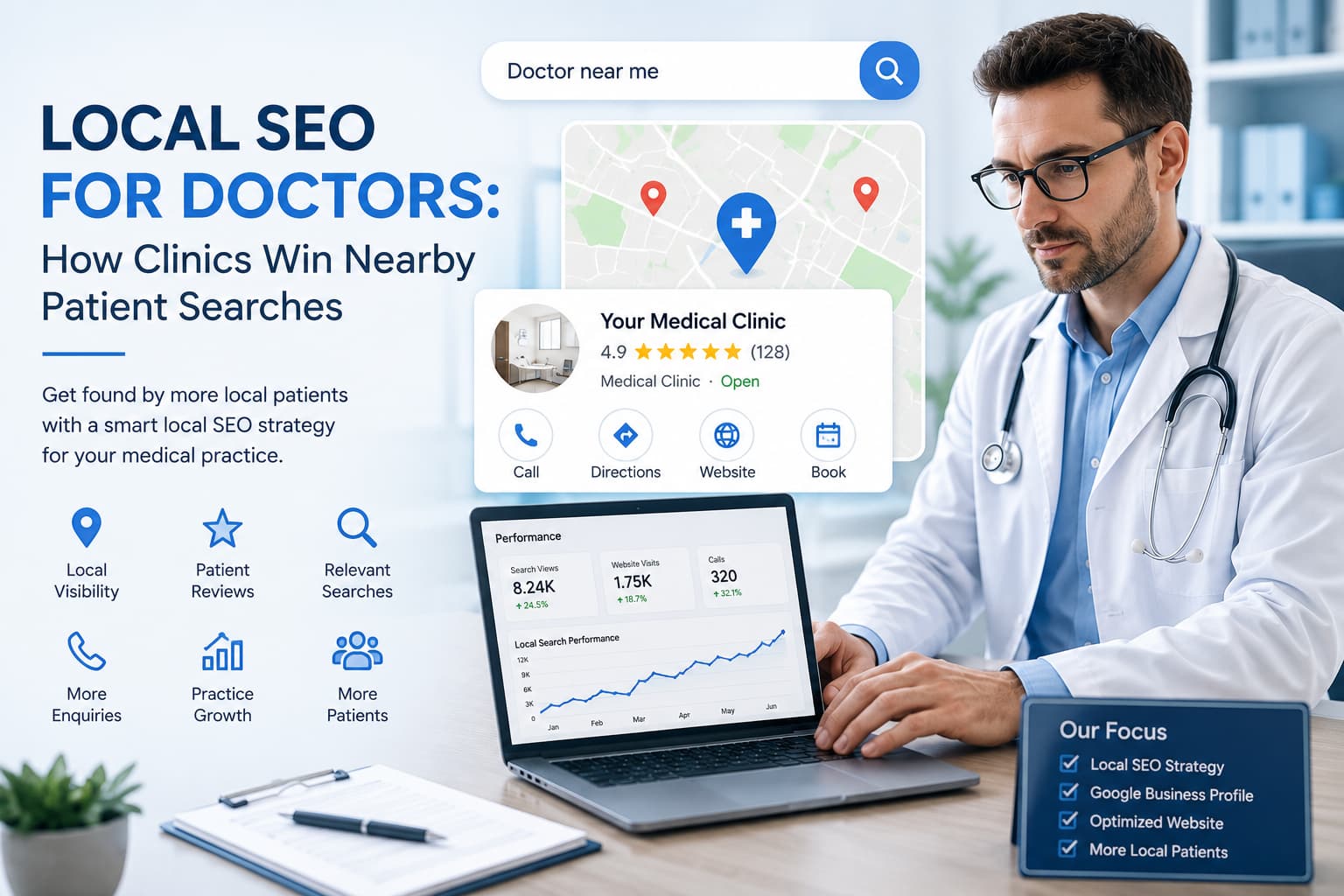
Patients searching for a doctor usually want more than general medical information. They want to know whether the practice is relevant to their needs, where it is located, which doctor they may see, and how to make an enquiry.
That is why local SEO for doctors should not rely only on a Google Business Profile.
A medical practice can appear on Google Maps and still lose potential enquiries if its website does not clearly connect clinic locations, medical services, doctor profiles, and appointment information.
Local visibility works best when the practice’s website and Google presence support the same patient journey.
Patients Search for Services and Locations Together
A patient may not search only for “doctor near me.”
They may search for:
- a private doctor in their area
- a specialist consultant nearby
- a clinic offering a specific service
- a doctor available at a named location
- a medical practice with appointment information
- a provider treating a particular concern
These searches combine service intent with local intent.
A clinic page that mentions only the town but does not explain the services available there may not fully answer the search.
Likewise, a strong medical service page may be less useful locally if patients cannot tell where the service is offered.
Local SEO for doctors works best when the service, doctor, and clinic location are clearly connected.
A Google Business Profile Is Only One Part of Local Visibility
A properly completed Google Business Profile can help a practice appear in local search and map results.
It can show:
- the clinic name
- address
- telephone number
- opening hours
- website
- reviews
- directions
- photos
But the profile cannot replace a useful medical website.
Patients may still click through to check:
- which doctors work at the practice
- what services are offered
- whether the clinic handles their particular need
- how consultations work
- where to enquire or book
A Google Business Profile may create the first impression, but the website often carries the next stage of the decision.
Doctors need both.
Location Pages Need More Than an Address
A clinic location page should do more than repeat the business name and postcode.
A useful location page can explain:
- which services are available at that clinic
- which doctors or consultants practise there
- how patients can contact the location
- whether appointments are required
- relevant access or parking information
- the areas the clinic reasonably serves
This helps patients understand whether they have reached the right place.
It also prevents the website from relying on thin location pages that differ only by city name.
A local page should help a patient make a decision, not simply target a place name.
Doctor Profile Pages Strengthen Local Trust
Patients often want to know who they may be seeing before they contact a practice.
A doctor profile page can support local SEO by clearly showing:
- the doctor’s name
- professional role
- clinical interests
- services connected to the doctor
- clinic location
- consultation information
- relevant qualifications where appropriate
A profile page should not sit isolated from the rest of the website.
It should link naturally to the relevant medical services and clinic locations.
For practices improving SEO for doctors, doctor profiles can help connect expertise, service relevance, and local availability.
A doctor page is more useful when patients can understand both who the doctor is and where they practise.
Service Pages Should Support Local Patient Intent
Medical practices often place every service on one broad page.
That may be convenient administratively, but it can make the site harder for patients to navigate.
Someone searching for a particular service usually needs a focused page that explains:
- what the service involves
- who it is relevant for
- which doctor or clinic provides it
- how to enquire
- where the service is available
A strong service page can support both general and local searches when it clearly links to the appropriate clinic location.
The goal is not to create dozens of near-duplicate city pages.
The goal is to create a clear relationship between the service and the place where patients can access it.
Consistent Practice Details Reduce Confusion
Local medical SEO also depends on consistent practice information.
The clinic name, address, telephone number, and website should be accurate across:
- the website
- Google Business Profile
- recognised healthcare directories
- social media profiles
- professional listings
- review platforms
Inconsistent information can confuse patients before it causes any search problem.
If one listing shows an old telephone number and another shows a previous clinic address, the patient may not know which information to trust.
Local SEO should make the practice easier to verify.
Reviews Support Decisions, but They Do Not Replace Useful Pages
Reviews can help prospective patients understand other people’s experience with a practice.
They may also influence whether someone feels comfortable making an enquiry.
However, reviews should not be treated as the entire local SEO strategy.
A practice can have positive reviews and still have:
- unclear service pages
- weak doctor profiles
- missing clinic information
- poor mobile usability
- no obvious enquiry route
Reviews support trust.
The website still needs to explain the medical practice itself.
A patient should not need to search through review comments to understand what the clinic offers.
Internal Links Should Reflect the Patient Journey
Internal links help patients move through the website in a logical order.
For example:
- a medical service page can link to the relevant doctor
- a doctor profile can link to the clinic where consultations take place
- a clinic page can link to the services available there
- an article can link to the relevant service or doctor page
- appointment information can link to the contact page
This creates a clearer relationship between the website’s key pages.
It also helps search engines understand how services, clinicians, and locations fit together.
Medical practices using medical SEO services should treat internal linking as part of the patient journey, not as a random exercise in adding more links.
Mobile Experience Matters in Local Medical Search
Many local searches happen on mobile devices.
A patient may be searching while travelling, during a break, or after being referred by someone else.
The website should make it easy to:
- read key service information
- view the clinic address
- call the practice
- open directions
- find appointment instructions
- submit an enquiry
A page that is technically visible but difficult to use on a phone can still lose the enquiry.
Local SEO does not stop when a page appears in search results.
The page must still help the patient take the next step.
Technical Problems Can Limit Local Pages
A practice may have useful local content but still struggle if important pages are not indexed correctly.
Common issues may include:
- location pages blocked from indexing
- duplicate page titles
- incorrect canonical tags
- weak internal links
- old clinic pages remaining live
- multiple pages competing for the same location
- inconsistent redirects after a practice moves
A medical website SEO audit can help identify whether the visibility problem comes from content, technical setup, or site structure.
Publishing more pages will not fix a location page that search engines cannot properly access or distinguish.
Multiple Locations Need a Clear Structure
Multi-location medical practices need to avoid creating a confusing set of pages.
Each genuine clinic location may deserve its own page, but the pages should reflect real differences such as:
- services available
- doctors practising there
- contact details
- opening times
- access information
- local patient instructions
Changing only the city name across several otherwise identical pages creates little value.
Each location page should have a real purpose.
The website should also make it easy to understand which doctors and services belong to each clinic.
Local SEO Should Match the Type of Practice
A private GP practice, specialist consultant, dental clinic, fertility clinic, and skin clinic may all need local search visibility, but their patient journeys are different.
A GP practice may depend heavily on nearby searches and appointment access.
A specialist consultant may receive patients from a wider region.
A fertility clinic patient may research for much longer before making contact.
This is why local medical SEO should not use one identical template for every provider.
Broader clinic SEO services can create the foundation, but each practice still needs a strategy that reflects its services, patients, and geographical reach.
How Doctors Can Improve Local Search Visibility
Doctors and medical practices should begin by reviewing whether their website answers the main local patient questions:
- What medical services are offered?
- Which doctor provides them?
- Where is the clinic located?
- Is the service available at that location?
- How can the patient make contact?
- What should happen next?
If those answers are scattered across unrelated pages, the website may need a clearer structure.
Local SEO for doctors is not simply about inserting a city name into headings.
It is about making the practice, doctor, location, and service understandable as one connected system.
Medical SEO Agency provides specialist SEO for doctors focused on medical website structure, local search visibility, doctor profiles, service pages, and patient enquiry journeys.
The strongest local medical websites do not merely say where the clinic is. They help nearby patients understand why the practice is relevant and how to take the next step.