


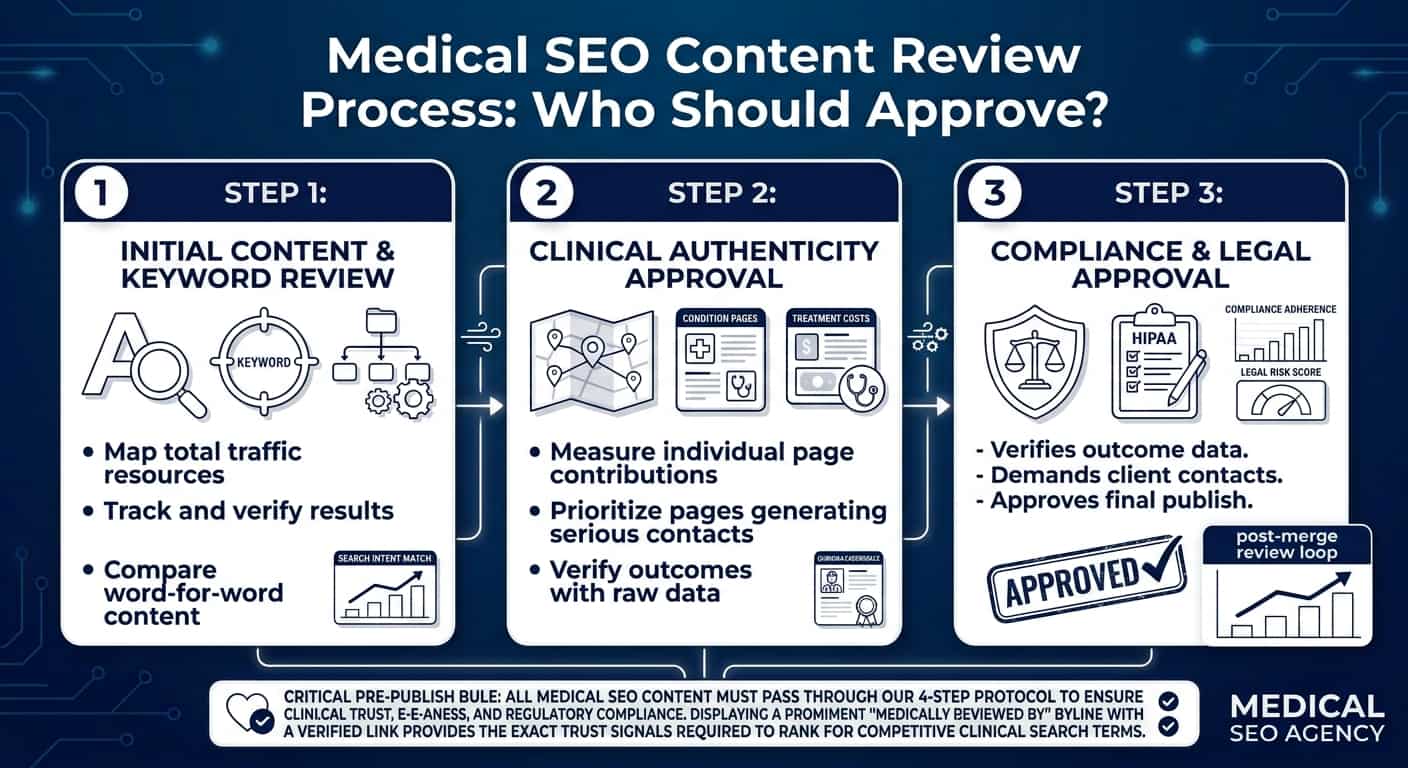
Medical SEO content should normally be reviewed by the person responsible for search intent and page structure, an appropriately qualified clinical reviewer for medical accuracy, and a designated business or compliance approver for claims, permissions and final publication. One person should not be expected to perform every role unless they genuinely have the required expertise and authority.
The right reviewers also depend on the content. A clinic contact page does not require the same scrutiny as a treatment comparison, a medicine-related claim or an article discussing symptoms. A useful medical SEO content review process therefore assigns responsibility according to risk instead of sending every page through the same slow approval chain.
Medical SEO content review responsibility matrix
The following matrix provides a practical starting point. Organisations should adapt it to their services, professional obligations and internal governance.
| Review task | Primary owner | Supporting reviewer | What should be confirmed? |
|---|---|---|---|
| Search intent and page purpose | SEO strategist | Service lead | The page answers a defined patient search and does not compete unnecessarily with another page. |
| Clarity and editorial quality | Medical writer or editor | SEO strategist | The wording is understandable, specific, neutral and organised around the reader’s needs. |
| Clinical accuracy and patient safety | Qualified clinical reviewer | Relevant service lead | Medical statements are accurate, current, appropriately qualified and within the reviewer’s competence. |
| Marketing claims and evidence | Compliance or marketing approver | Clinical reviewer | Objective claims are supported, important limitations are visible and the content is not misleading. |
| Medicines or regulated-product references | Specialist compliance or legal reviewer | Clinical reviewer | The content complies with applicable medicines, device and advertising requirements. |
| Prices, availability and operational details | Clinic or practice manager | Service lead | Prices, locations, clinicians, appointment routes and service availability are correct. |
| Final approval and publication | Named publishing owner | SEO or web editor | Required approvals are recorded, the correct version is published and review dates are assigned. |
The key distinction is between being consulted and having approval authority. Several people may comment on a draft, but each review stage should have one named owner who can approve it or return it with specific changes.
What is each reviewer actually responsible for?
The SEO strategist
The SEO strategist should define why the page exists, which patient need it addresses and where it belongs within the website. Their review should cover search intent, page mapping, internal linking, headings, metadata and possible overlap with existing content.
The SEO reviewer should not approve clinical statements merely because they appear in a competing page or search result. Search visibility expertise does not establish medical accuracy.
The medical writer or editor
The writer or editor is responsible for turning the approved brief and evidence into clear, useful content. This includes explaining unfamiliar terms, removing unnecessary repetition, presenting risks and limitations visibly, and avoiding language that creates unjustified certainty.
A writer may have extensive healthcare experience without being qualified to provide final clinical approval. The workflow should distinguish editorial competence from clinical accountability.
The clinical reviewer
The clinical reviewer should assess statements that could influence a person’s understanding of symptoms, treatment, suitability, outcomes, risks or next steps. The reviewer should have relevant knowledge of the subject and work within their professional competence.
The review should confirm more than whether the draft contains an obvious factual error. It should consider whether:
- Important risks or limitations have been omitted
- Possibilities are presented as certainties
- The evidence cited supports the precise statement being made
- Information is current enough for the subject
- The content could encourage an unsafe delay or inappropriate action
- The reviewer’s qualifications are relevant to the topic
The NHS standard for creating health content recommends defining and following a clear content-production process. NHS guidance on review dates also states that when clinical content changes, a clinician should sign it off.
The compliance or marketing approver
Clinical accuracy does not automatically make a marketing claim acceptable. A statement may be medically plausible but still be misleading if it exaggerates an outcome, omits a significant qualification or cannot be substantiated.
The CAP Code rules on misleading advertising require marketers to hold documentary evidence for objective claims before publication. Section 12 of the CAP Code applies additional scrutiny to marketing communications concerning medicines, medical devices, treatments and health-related products.
The compliance review should therefore examine claims such as:
- Success or response rates
- Superiority over another provider or treatment
- Claims that a treatment is safe, painless or risk-free
- Statements based on awards, rankings or patient numbers
- Testimonials that imply a typical or guaranteed outcome
- Time-sensitive prices and promotional offers
The practice manager or service owner
The operational reviewer verifies the facts that neither the SEO team nor clinical reviewer may control. These include service availability, consultation routes, prices, opening hours, locations, named clinicians and what happens after an enquiry.
This review prevents a clinically accurate page from sending patients toward an outdated telephone number, unavailable treatment or clinician who no longer works at that location.
The publishing owner
The publishing owner confirms that all required reviews have been completed and that the approved version is the version being published. They should also record the publication date, content owner and next review date.
The publishing owner is not necessarily the person who uploads the page into WordPress. Publication authority and the technical act of pressing the publish button are separate responsibilities.
Which content requires clinical review?
Not every website edit requires a clinician. Requiring clinical approval for a spelling correction or navigation label creates delays without improving safety. A risk-based system is more practical.
| Risk level | Examples | Minimum review route |
|---|---|---|
| Lower risk | Contact details, opening hours, navigation, neutral organisational information | Editorial or operational review |
| Moderate risk | General service descriptions, clinician profiles, appointment preparation, treatment-process explanations | Editorial review plus relevant service or clinical check |
| Higher risk | Symptoms, diagnosis, treatment suitability, outcomes, risks, comparisons, medicines and medical claims | Qualified clinical review plus compliance or specialist review where applicable |
The final classification should consider both the subject and the consequence of an error. A short statement about treatment eligibility may require more scrutiny than a much longer page about parking and accessibility.
When is specialist legal or regulatory review needed?
A clinic should escalate content when it concerns an area governed by specific rules or when the internal team cannot confidently determine whether a claim is permitted.
This may include content involving prescription medicines, medical devices, promotional comparisons, complex testimonials, before-and-after imagery, regulated professionals or claims about treatment outcomes. The MHRA guidance on advertising medicines explains that medicines advertising must follow legal requirements and points clinics to the Blue Guide for detailed guidance.
GMC professional standards are also relevant where doctors communicate publicly about services. The GMC’s guidance on trust and professionalism says medical professionals must not exploit people’s vulnerability or lack of medical knowledge and should communicate in line with their duty to protect patients and the public.
This article provides a workflow framework, not legal or regulatory advice. Organisations should obtain appropriate specialist advice when the applicable rules or responsibilities are unclear.
A practical medical SEO content review workflow
- Assign the page purpose. Record the intended audience, search need, page owner and relationship to existing pages.
- Classify the risk. Decide whether the content is lower, moderate or higher risk before drafting begins.
- Prepare the evidence pack. Store the approved source material, claim evidence and any internal service information used.
- Draft for patients and search intent. The writer prepares clear content without expanding claims beyond the available evidence.
- Complete editorial and SEO review. Check clarity, structure, duplication, internal links and alignment with the assigned page purpose.
- Complete clinical review where required. The named reviewer approves, rejects or requests specific amendments.
- Complete compliance review where required. Check objective claims, qualifications, testimonials, promotions and regulated references.
- Verify operational facts. Confirm prices, clinicians, locations, services and contact routes.
- Publish the approved version. Record approvers, publication date, content owner and review date.
- Monitor and maintain. Review performance without making unapproved clinical changes simply to improve rankings.
What should be recorded in the approval log?
A complicated system is not required. A spreadsheet, project-management record or content platform can work if it records:
- Page title and URL
- Content owner
- Risk classification
- Source documents and evidence
- Writer and SEO reviewer
- Clinical reviewer and relevant credentials
- Compliance or legal reviewer, where required
- Approval status and date
- Published version
- Next scheduled review date
The log provides accountability and makes future updates easier. It also prevents an old, unapproved draft from being published after the reviewers have signed off a different version.
Common review-process failures
- Asking a clinician to review a page without identifying which statements need attention
- Treating competitor websites as evidence for medical claims
- Allowing an SEO writer to approve their own medical wording
- Requesting feedback from many people without naming a final approver
- Publishing first and requesting clinical approval afterwards
- Changing approved medical statements during on-page optimisation
- Showing a review date without retaining evidence that a review occurred
- Using one clinician’s approval for subjects outside their competence
Who is ultimately accountable?
The organisation publishing the content should define who has final authority and accountability. An external SEO partner can research search behaviour, plan pages, improve structure and manage the workflow, but it should not silently assume clinical or regulatory authority that belongs elsewhere.
A dependable process makes those boundaries visible. SEO determines how the right information can be discovered and understood. Clinical reviewers protect accuracy and patient safety. Compliance reviewers assess claims and applicable rules. The publishing organisation decides when the approved page is ready to go live.
Final takeaway
Medical SEO content should not pass through one vague approval stage. It needs named responsibilities for search intent, editorial quality, clinical accuracy, marketing claims, operational facts and final publication.
The most efficient process is risk-based. Give higher-risk content the scrutiny it needs, allow low-risk operational updates to move through a lighter route, and retain an approval record for both. If your website lacks a clear page inventory or review workflow, a structured medical SEO audit can identify where content, ownership and patient journeys require attention.
You may also find useful: When Should a Healthcare Website Consolidate Similar Treatment Pages? · What Website and Analytics Access Should an SEO Provider Request From a Clinic?
Related services: Pharma SEO · SEO for Aesthetics Clinics