

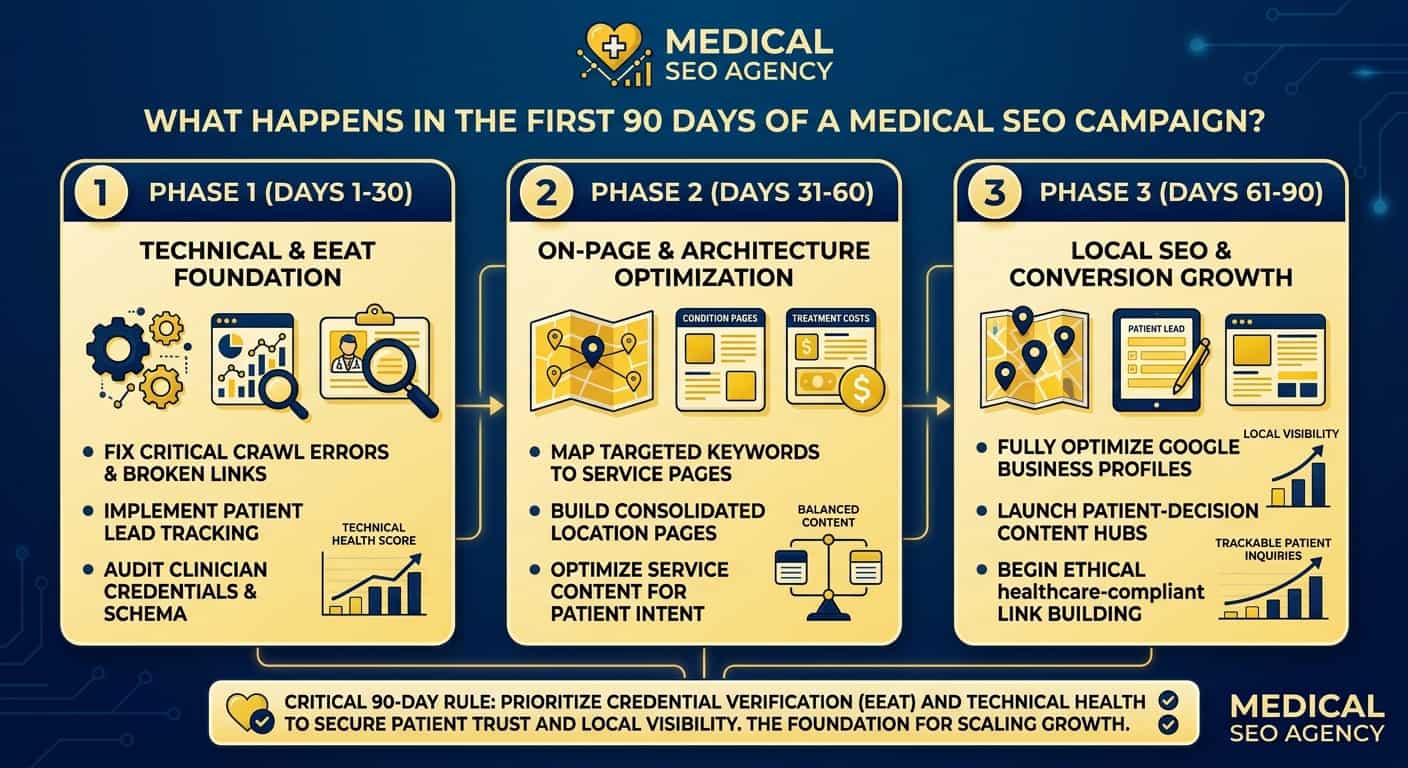
The first 90 days of a medical SEO campaign should establish reliable measurement, identify the pages that matter most, correct issues restricting visibility and create a controlled process for improving medical content. It should not begin with publishing large volumes of loosely connected articles.
A clinic may not reach its full ranking potential within three months, particularly in a competitive location or speciality. However, by day 90 it should be possible to show what was discovered, what was changed, what early movement has occurred and what will be prioritised next.
This phased framework explains what clinics should expect during the medical SEO first 90 days and how each stage should lead logically into the next.
The 90-day medical SEO framework at a glance
| Period | Primary objective | Expected output |
|---|---|---|
| Days 1 to 30 | Establish evidence and priorities | Measurement baseline, technical findings, page map and prioritised action plan |
| Days 31 to 60 | Repair and strengthen priority pages | Implemented technical fixes, improved service pages and documented review workflow |
| Days 61 to 90 | Expand evidence and evaluate early movement | Supporting content, stronger internal links, performance review and next-quarter plan |
Days 1 to 30: establish evidence before making changes
The first month should answer a basic question: what is currently preventing the website from attracting and converting relevant patient searches?
This requires more than running an automated audit. The SEO provider should understand the organisation, its locations, specialities, clinicians, commercially important services and any restrictions affecting how medical information can be presented.
1. Confirm access and measurement
The provider should confirm access to Google Search Console, analytics, the website platform, tag-management tools, the business profile and relevant call or booking systems. Access should be appropriate to the work being performed and controlled by the clinic.
Existing conversion tracking should then be tested. Form submissions, telephone calls and online bookings should not simply be assumed to work because an event appears in an analytics account. Test enquiries should be completed and verified.
The initial measurement record should normally include:
- Organic clicks and impressions
- Non-branded search visibility
- Performance of priority service and location pages
- Tracked calls, forms and bookings from organic visits
- Indexing and coverage issues
- Relevant local search visibility
This baseline prevents the campaign from relying on isolated ranking screenshots or traffic totals that do not reflect patient demand.
2. Map services, clinicians and locations
Medical websites often contain several possible page types for the same search: a treatment page, clinician profile, speciality page, clinic location or general article. The first month should determine which page should satisfy each important patient search.
The page map should identify:
- The searches assigned to each priority page
- Services that do not yet have an appropriate page
- Pages competing for the same intent
- Thin location pages with little unique information
- Content that should be retained, consolidated or redirected
This work is particularly important before approving new content. Publishing another page for an intent already covered can divide relevance instead of increasing it.
3. Complete technical and trust reviews
The technical review should focus on issues that affect important pages, rather than producing a long export of low-priority warnings. Indexing directives, canonical tags, redirects, duplicate URLs, internal links, mobile usability, page performance and structured data should all be examined in context.
The trust review should assess whether users can identify the organisation and the people responsible for services and medical content. Relevant clinician credentials, professional registrations, authorship, review responsibility, clinic contact information and content-review dates should be checked for clarity and accuracy.
A structured medical SEO audit can help distinguish urgent barriers from improvements that can wait until a later phase.
Decision gate at day 30
By the end of the first month, the clinic should be able to approve a prioritised implementation plan. Every recommended action should identify the affected page or template, the reason for the change, the person responsible and any clinical or organisational approval required.
Days 31 to 60: repair foundations and improve priority pages
The second month should move from diagnosis to controlled implementation. It is normally better to improve a defined group of high-value pages properly than to make superficial changes across the entire website.
1. Implement high-impact technical fixes
Technical work should begin with issues that stop priority pages from being discovered, indexed or interpreted correctly. Depending on the website, this may include removing accidental noindex directives, correcting canonicals, repairing internal links, consolidating duplicate URLs or redirecting retired pages.
Changes should be logged and checked after deployment. A recommendation is not complete merely because it has been sent to a developer.
2. Strengthen the pages closest to patient demand
Priority treatment and service pages should be reviewed against the actual intent shown in search data. The objective is not to insert a keyword repeatedly. The page should help a suitable patient understand the service, the provider, the location, the likely next step and any important limitations.
Depending on the service, useful improvements may include:
- A clearer explanation of the treatment or consultation
- Information about who provides the service
- Relevant qualifications and registrations
- Clinic availability and practical location information
- Transparent pricing or an explanation of cost factors
- Answers to genuine pre-appointment questions
- A clear booking or enquiry pathway
All medical statements should pass through the organisation’s normal review process. SEO should improve how accurate information is structured and found, not encourage unsupported claims.
3. Improve internal pathways
Relevant articles, clinician profiles, service pages and location pages should connect logically. Internal links help search engines understand relationships, but they also help patients move from initial research to an appropriate next step.
Links should be placed because the destination genuinely helps the reader. Site-wide blocks of repetitive keyword links are rarely a substitute for thoughtful page relationships.
Decision gate at day 60
At the end of month two, the clinic should review which approved actions have actually been implemented. Any delays involving clinical review, development access or internal approval should be recorded because these constraints will affect the campaign timeline.
Days 61 to 90: build support and evaluate early movement
The third month should use the evidence gathered so far to expand the campaign carefully. This is the stage to support priority pages with useful content, strengthen local signals and assess early performance changes.
1. Publish content that closes an identified gap
New content should have a defined role. It may answer a question that cannot be covered properly on a service page, explain a decision patients commonly face or support a priority treatment with useful internal links.
Before commissioning a new article, the team should be able to state:
- The patient question it answers
- The existing page it supports
- Why it does not duplicate current content
- Who will author or review it
- What appropriate next step it offers the reader
2. Strengthen local and organisational evidence
For organisations with physical clinics, location information should be checked across the website and relevant profiles. Each clinic page should describe the real services, clinicians, facilities and contact details associated with that location.
This stage may also identify legitimate opportunities for professional citations, partnerships, directories or publications. Link acquisition should focus on relevance and credibility rather than purchasing large quantities of unrelated links.
3. Review early indicators without overclaiming results
Ninety days is often enough to observe crawling, indexing and early search movement, but it is not always enough to judge the full commercial outcome of the campaign. Highly competitive queries may require sustained improvements over a longer period.
The day-90 review should compare the current position with the original baseline and distinguish completed work from outcomes. Useful questions include:
- Have priority pages been crawled and indexed correctly?
- Are those pages receiving more relevant impressions?
- Are non-branded queries moving toward page one?
- Has organic engagement with booking and enquiry actions changed?
- Which approved actions remain unimplemented?
- What evidence should determine the next 90-day priorities?
What should not happen during the first 90 days?
Several patterns should concern a clinic:
- Publishing dozens of articles before reviewing existing service pages
- Reporting rankings without explaining the searches, locations or landing pages involved
- Making medical content changes without an agreed review process
- Creating near-identical pages for every treatment and location combination
- Building large numbers of irrelevant or unverifiable links
- Reporting activity without confirming whether recommendations were implemented
- Guaranteeing rankings or patient numbers within a fixed period
What should a clinic possess by day 90?
A well-managed first quarter should leave the clinic with more than a collection of monthly reports. It should have:
- A verified measurement baseline
- A documented map of priority pages and search intent
- A prioritised technical and content record
- Evidence that approved fixes were deployed and checked
- A defined medical-content review process
- Improved priority service, clinician or location pages
- An evidence-led plan for the following quarter
Final takeaway
The first 90 days should create control, clarity and evidence. Month one establishes what is happening, month two repairs and strengthens the pages closest to patient demand, and month three builds support while evaluating early movement.
If an organisation cannot explain what was measured, what changed and why the next actions were selected, the campaign has not yet established a dependable foundation.
Medical SEO Agency helps healthcare organisations investigate technical, content and patient-journey problems before scaling their search strategy. For a structured assessment of your current position, explore our SEO audit services.
You may also find useful: How Should a Medical Practice Set an SEO Budget? · What Should a Medical Practice SEO Report Include? · Which SEO Improvements Should a New Medical Clinic Prioritise First?
Related services: Clinic SEO Services · Local SEO for Med Spas