


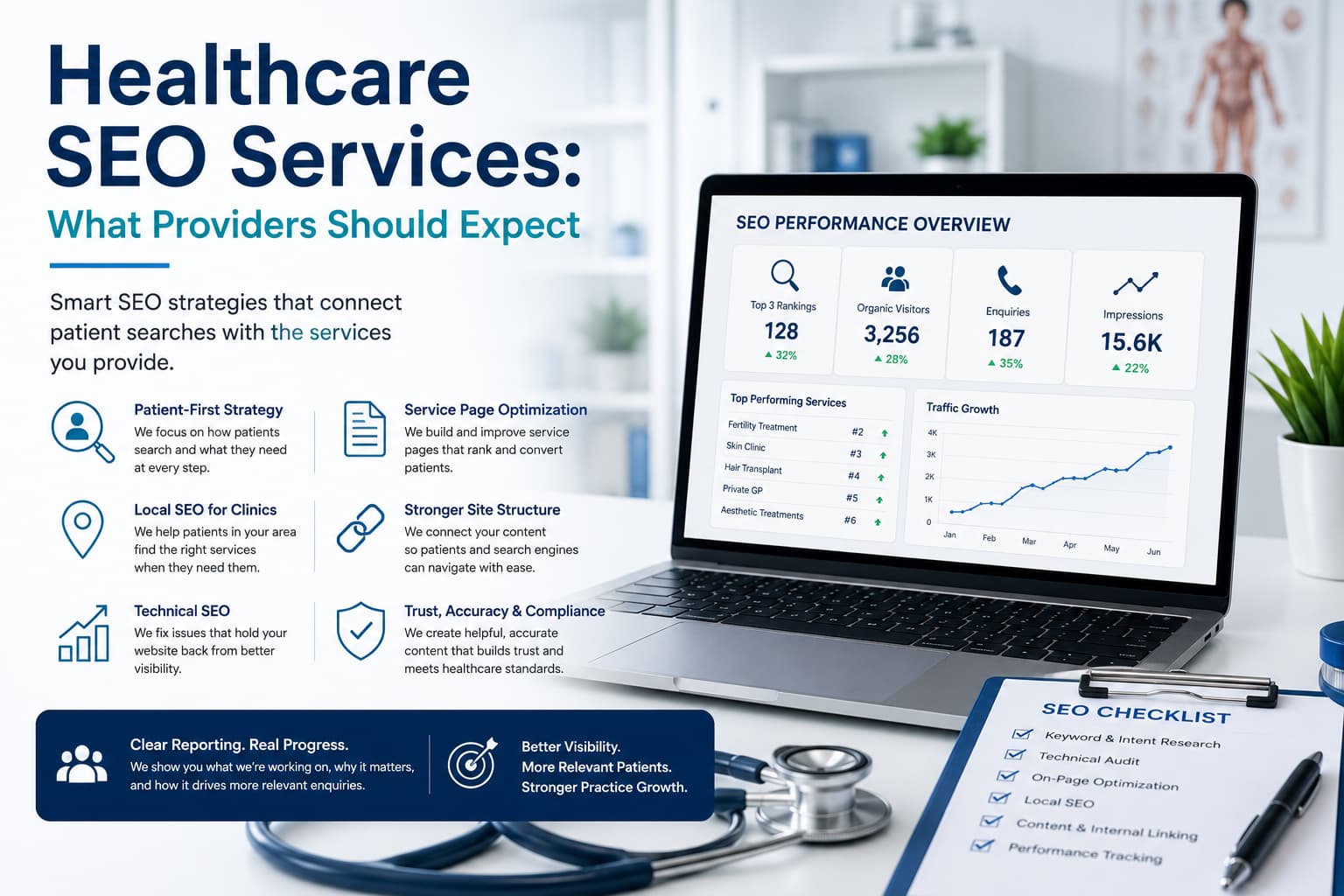
Healthcare providers often invest in SEO without knowing what the service should actually involve.
One agency may talk mainly about rankings. Another may focus on content. Others may send monthly reports filled with traffic graphs but give little explanation of how the work connects to patient enquiries.
Good healthcare SEO services should be easier to understand.
The work should connect patient search behaviour, medical website structure, local visibility and the pages most likely to influence an enquiry.
Healthcare SEO Should Start With How Patients Search
Healthcare SEO is not simply about adding medical keywords to a website.
Patients may search differently depending on where they are in the decision process.
Someone may begin with a broad concern. Later, they may search for a treatment, clinic type, specialist or provider in a specific location.
For example, a patient may move from researching a condition to comparing individual doctors, clinics or treatment providers.
An SEO strategy should identify these different search stages and decide which pages need to support them.
This is one reason specialist medical SEO agency should look beyond broad traffic numbers.
The question is not only whether more people are visiting the website.
The more important question is whether relevant patients are finding useful pages.
A Proper Website Review Should Come Before Random Content
Publishing more blogs is not always the first SEO task a healthcare provider needs.
A website may already have useful treatment pages but struggle because the structure is unclear.
Common issues can include:
- important services hidden several clicks deep
- multiple pages covering very similar topics
- weak internal links
- unclear page titles
- outdated pages remaining indexable
- poor local service information
In that situation, producing another 20 generic articles may add more content without solving the underlying problem.
Healthcare SEO services should normally begin with a review of the existing website, important services and current search visibility.
The purpose is to understand what already exists before adding more pages.
Different Healthcare Providers Need Different SEO Strategies
A broad healthcare SEO template rarely works equally well across every medical niche.
The way patients search for a dentist may be very different from how someone researches fertility treatment or chooses a specialist clinic.
For doctors, search visibility may need to connect practitioner expertise, medical services and location.
For dentists, individual treatment pages and local search visibility may play a stronger role in the enquiry journey.
A broader clinic SEO strategy may need to organise several services, practitioners and patient search intents within one website.
The SEO approach should reflect the actual provider rather than forcing every healthcare business into the same structure.
Service and Treatment Pages Should Be a Major Focus
For many healthcare providers, service pages are closely connected with patient enquiries.
A clinic may rank for informational content while its actual treatment pages remain difficult to find.
That creates visibility without a clear path towards an appointment or consultation.
SEO work should therefore review whether important services have dedicated pages where needed.
These pages should clearly explain:
- what the service involves
- who it may be relevant for
- where it is available
- what patients can expect next
- how to contact the provider
This does not mean turning treatment pages into keyword-heavy articles.
The page still needs to feel useful to a patient.
Search visibility and patient clarity should support each other.
Specialist Clinics Often Have More Complex Search Journeys
Some healthcare sectors involve longer research and comparison stages.
A patient researching fertility treatment may compare procedures, clinic locations and treatment options before making an initial enquiry.
That means a fertility clinic SEO strategy may need to connect treatment information, patient questions and clinic pages carefully.
The same principle applies to specialist services such as skin clinic SEO.
Patients may search by condition, concern, treatment or provider type.
The website needs to create a clear relationship between those searches and the services actually offered.
A single broad “Treatments” page may not provide enough clarity.
Internal Linking Should Connect Medical Information With Services
Healthcare websites often publish useful medical information but fail to connect it with relevant services.
A blog may answer a patient question and then end with no clear next step.
A practitioner page may mention specialist expertise without linking to the treatment being discussed.
A healthcare SEO provider should review these connections.
For example, informational content about recovery, mobility or treatment options could support relevant pages for physical therapy clinics where the subject genuinely overlaps.
Likewise, treatment information can link to appropriate practitioner, clinic or consultation pages where useful.
Internal linking should help patients move through the website.
It should not be a mechanical SEO exercise where every page links to the homepage.
Local SEO May Be Essential for Clinics and Providers
Many healthcare searches have a strong location element.
Patients may be looking for a provider they can realistically visit.
This is particularly important for clinics, dentists, GPs and physical therapy providers where patients often search by service and location.
Healthcare SEO services may therefore include reviewing:
- clinic location pages
- contact details
- Google Business Profile information
- local service relevance
- location-specific treatment availability
Providers with several clinics may need additional attention.
Patients should be able to understand which services are available at each location.
Creating duplicate city pages with slightly changed wording is not a strong local SEO strategy.
The location information needs to reflect the actual service.
Aesthetic and Cosmetic Healthcare Needs Its Own Search Approach
Aesthetic and cosmetic healthcare often involves a particularly competitive comparison journey.
Patients may research treatments, review different providers and compare locations before making contact.
An SEO strategy for aesthetic clinics should therefore consider both treatment-specific searches and the trust information patients may review before enquiring.
Similar challenges can appear in areas such as hair restoration.
Patients researching procedures may spend significant time comparing providers, which makes clear treatment pages and useful supporting information important for hair transplant clinic SEO.
The goal is not to create exaggerated promotional content.
The website needs to make services easier to find and understand.
Content Should Support Real Patient Questions
Healthcare content has a purpose beyond publishing frequency.
Useful content can support patients who are still researching a treatment or provider.
However, topics should be based on genuine patient search behaviour and the services the organisation provides.
A fertility clinic, skin clinic and private GP practice will not need the same content strategy.
Even within one healthcare organisation, different treatments may have very different patient journeys.
Healthcare SEO services should therefore consider questions such as:
What does a patient need to understand before considering this service?
What concerns may delay an enquiry?
Which information is already available on the website?
Which questions deserve a standalone article, and which should simply be answered on the treatment page?
This approach creates a more useful content structure than publishing broad medical articles with little connection to the provider’s services.
Technical SEO Should Not Be Ignored
Strong content can still struggle if search engines have difficulty accessing or understanding the website.
Healthcare SEO services should include appropriate technical checks.
The exact issues will vary, but the review may look at:
- crawlability
- indexation
- internal site structure
- broken links
- duplicate pages
- page speed
- mobile usability
- structured data where appropriate
Technical SEO does not mean making random changes to a website every month.
The work should identify actual problems and prioritise issues based on their likely impact.
Trust and Accuracy Matter in Healthcare Content
Healthcare is a trust-sensitive sector.
Patients may be making decisions connected with treatment, health concerns or private medical care.
Content should therefore be reviewed carefully.
SEO copy should not use exaggerated promises simply to make a page sound more persuasive.
Healthcare providers also need clear information about clinicians, services and the organisation behind the website.
A visitor who finds a treatment page through Google may never have heard of the provider before.
The page needs to answer the search while also giving the patient enough context to decide whether they want to learn more.
This is an important difference between healthcare SEO and more generic lead-generation SEO.
Reporting Should Explain What Is Being Worked On
Healthcare providers should expect more than a monthly ranking spreadsheet.
SEO reporting should explain what work has been completed and why.
For example:
- which service pages were improved
- which technical problems were found
- where internal linking was strengthened
- which search opportunities are being reviewed
- what changes are visible in search performance
Not every SEO change produces an immediate ranking increase.
Reporting should make the strategy understandable without pretending every month has delivered a dramatic result.
Providers should be able to see how the work connects with their website and search visibility.
What Should Healthcare Providers Expect From SEO?
Healthcare SEO should be structured around the actual organisation.
A clinic with one location and five treatments will need a different strategy from a healthcare group with several brands, practitioners and clinics.
Providers should expect SEO work to review patient search behaviour, important services, website structure and current visibility before deciding what needs to be changed.
For organisations comparing a healthcare SEO agency, it is worth looking beyond broad promises about traffic.
The stronger question is whether the strategy clearly connects search demand with the services patients are actually trying to find.
Healthcare SEO should make important information easier to discover, understand and act on.