


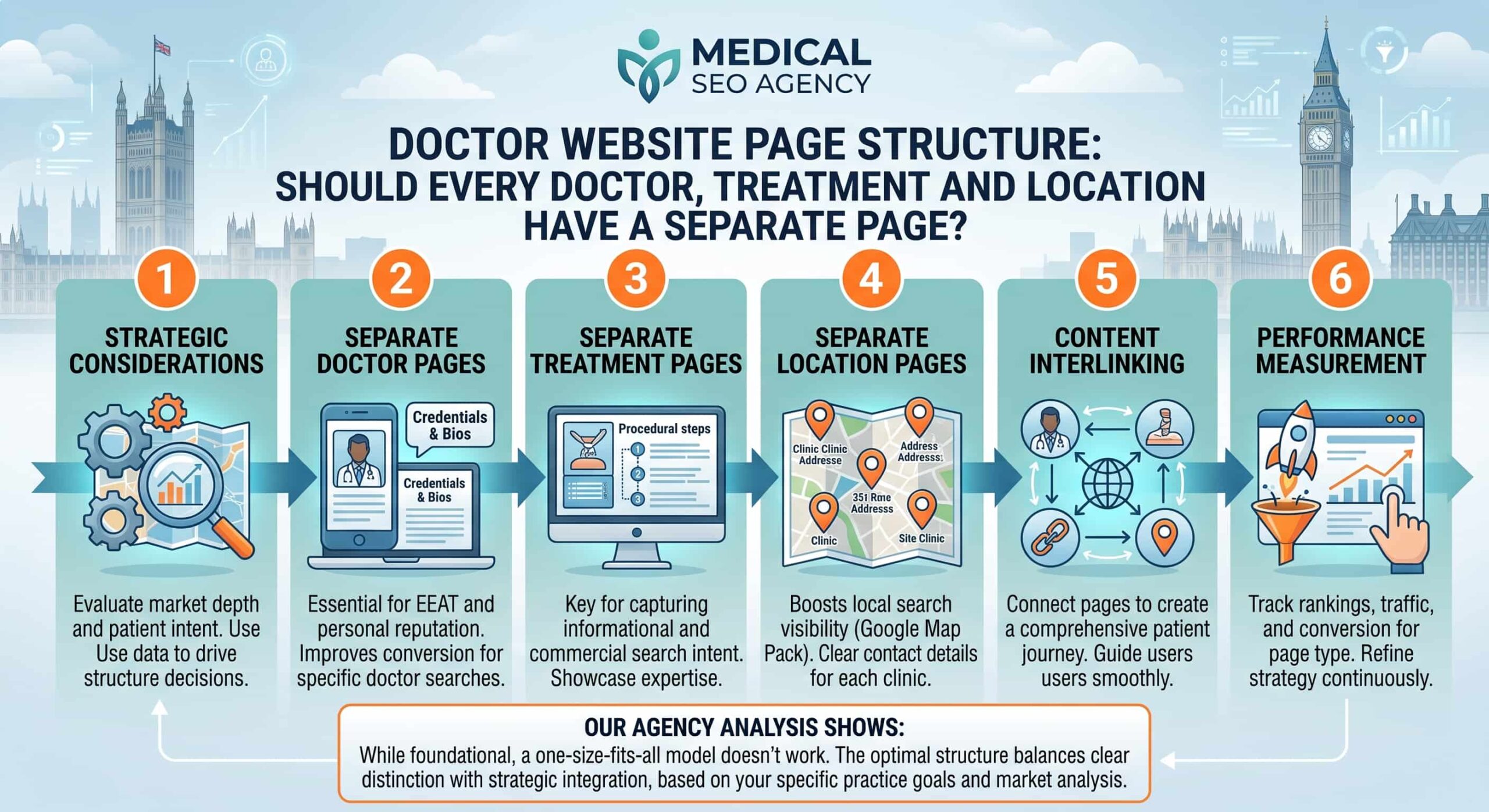
A good doctor website page structure does not automatically give every doctor, treatment and location a separate URL. A separate page is justified when it answers a distinct patient need, contains substantial information and represents a genuine service, clinician or clinic location.
Creating too few pages can prevent important services from gaining visibility. Creating too many can produce thin content, duplication and several pages competing for the same searches.
The correct structure sits between these extremes.
This guide provides a decision framework for determining when a private medical website needs separate doctor, treatment and location pages.
The Short Answer
Use a separate page when all four statements are true:
- The subject has a distinct patient-search intent.
- The practice can provide substantial and specific information.
- The page represents a real doctor, treatment or clinic location.
- A visitor would benefit from reaching that page directly from Google.
Keep subjects together when separating them would produce repetitive pages that differ only by a name, location or slightly altered introduction.
Why Doctor Website Page Structure Matters
Patients do not all enter a medical website through the homepage.
They may search for:
- A named consultant
- A medical specialty
- A symptom
- A condition
- A treatment
- A diagnostic test
- A clinic location
- An appointment type
- A second opinion
- A private consultation
The website needs an appropriate landing page for the searches the practice genuinely wants to serve.
For example, a patient searching for a private cardiologist may need a specialty page. Someone searching for an atrial fibrillation specialist may need a condition or consultant page. A patient searching for a clinic in a particular location may need a genuine clinic page.
Trying to make one general services page answer every search can weaken relevance and make the patient journey confusing.
However, creating separate pages for every slight keyword variation can create a different problem. Search engines may struggle to identify which page should rank, while patients encounter several pages containing nearly identical information.
Doctor Website Page Structure Decision Framework
Before creating a separate page, score the proposed subject against these five criteria.
| Criterion | Question |
|---|---|
| Search intent | Are patients searching for this subject as a distinct need? |
| Clinical distinction | Does it represent a genuinely different doctor, treatment, condition or location? |
| Content depth | Can the practice provide substantial information without repeating another page? |
| Patient value | Would reaching this page directly help a patient make a decision? |
| Conversion route | Can the page lead to an appropriate consultant, service or appointment? |
How to interpret the result
- Five clear yes answers: A separate page is probably justified.
- Three or four yes answers: Review the search results and existing website structure.
- One or two yes answers: Keep the subject within a broader page.
- No clear yes answers: Do not create the page.
This is a planning framework rather than a fixed Google rule. Search demand, clinical services and website authority still need individual assessment.
When Does a Doctor Need a Separate Profile Page?
Each doctor should normally have a separate profile when patients can independently choose, research or book with that clinician.
A separate doctor page is particularly useful when the clinician has:
- A distinct medical specialty
- Named areas of clinical interest
- Individual qualifications
- Verifiable professional registration
- Specific clinic locations
- Treatments they personally provide
- Different appointment availability
- Research, publications or professional roles
- A direct referral or booking pathway
What a doctor profile should contain
A useful profile may include:
- Full name and professional title
- Medical specialty
- Conditions assessed
- Treatments or procedures provided
- Qualifications
- GMC registration information
- Current hospital or clinic appointments
- Professional memberships
- Research and publications
- Languages spoken
- Locations
- Appointment options
- Insurance information
- Links to relevant treatments and conditions
Patients can check a doctor’s registration through the General Medical Council register. Providing verifiable information is more useful than relying on unsupported descriptions such as “leading” or “the best”.
When separate doctor pages are unnecessary
A separate page may not be justified when:
- The individual does not see patients
- The profile contains only a photograph and two sentences
- Every profile repeats the same practice description
- Patients cannot book or enquire about that doctor
- The clinician’s role is not relevant to the services being targeted
- The page exists only to repeat a doctor keyword
A staff directory and detailed doctor profile serve different purposes. A directory helps visitors browse. A profile should help them evaluate a specific clinician.
When Does a Treatment Need a Separate Page?
A treatment deserves a separate page when it represents a distinct patient decision and the practice can explain it properly.
Separate pages are often appropriate when treatments differ in:
- Purpose
- Patient suitability
- Clinical process
- Preparation
- Risks and limitations
- Recovery
- Cost
- Consultant involvement
- Location
- Appointment pathway
For example, a fertility clinic may need separate pages for IVF, IUI, fertility testing and egg freezing. Combining them into one general fertility services page may not give patients enough information about any individual option.
A cardiology practice may need separate pages for diagnostic tests, rhythm treatments and screening services when each has its own patient intent and clinical pathway.
Questions to ask before creating a treatment page
- Do patients search for this treatment specifically?
- Is it meaningfully different from another service?
- Can the practice explain who it may be suitable for?
- Can the process be described accurately?
- Are there specific consultants associated with it?
- Is the treatment available at particular locations?
- Can the page provide a clear next step?
- Would the content remain useful without repeating another page?
If the answer is yes across most of these questions, a separate page is likely appropriate.
When treatments should remain combined
Keep treatments together when:
- They are minor variations of the same service
- Patients would not recognise the distinction
- The clinical process is almost identical
- Separate pages would contain mostly duplicated content
- The practice cannot provide enough information for each page
- Search results treat them as one intent
- One broader page can answer the question more clearly
A practice could use separate sections within one treatment page, supported by a contents menu and clear headings.
Treatment pages should not become medical encyclopaedias
The purpose of a private treatment page is not to reproduce every fact available about a procedure.
It should help the patient understand:
- What the treatment is
- Why it may be considered
- Who provides it
- What the process involves
- Where it is available
- What happens next
Medical claims must be accurate, appropriately reviewed and written within the scope of the service actually offered.
When Does a Condition Need a Separate Page?
Conditions and treatments represent different patient questions.
A condition page addresses:
- What might be causing the concern?
- Which symptoms may be relevant?
- When should specialist assessment be considered?
- Which investigations may be used?
- What treatment routes might follow?
A treatment page addresses:
- What is the treatment?
- Who might receive it?
- What does the process involve?
- Which doctor provides it?
- How can a patient arrange an appointment?
A private doctor website may need both when the condition and treatment have distinct patient-search demand.
Example structure
A cardiology website could use:
/conditions/atrial-fibrillation//treatments/catheter-ablation//doctors/dr-example-cardiologist/
The condition page explains atrial fibrillation. The treatment page explains catheter ablation. The doctor profile demonstrates relevant expertise.
The pages should link to one another because they serve connected but different patient needs.
When not to separate condition pages
Do not create a page for every symptom or clinical term when:
- The practice does not provide a relevant service
- The information would be extremely brief
- Several terms represent the same patient intent
- The page would repeat an existing treatment page
- The subject cannot be covered responsibly
- There is no appropriate appointment pathway
A symptom may be better covered as a section within a broader condition or specialty page.
When Does a Clinic Location Need a Separate Page?
A separate location page is justified when it represents a genuine place where patients can receive care.
A useful clinic location page should contain:
- Clinic name
- Full address
- Telephone number
- Opening or appointment information
- Consultants available there
- Treatments or services provided
- Directions
- Parking or public transport information
- Accessibility information
- Relevant photographs
- Enquiry or appointment route
For regulated services in England, provider and location information may also be available through the Care Quality Commission.
Questions to ask before creating a location page
- Does the practice genuinely operate at this location?
- Can patients attend appointments there?
- Are particular clinicians available there?
- Are specific services provided there?
- Does the location have its own contact or booking information?
- Can the page provide useful access information?
- Would a patient search for this service in that location?
If the only difference is the place name, a separate page is unlikely to provide enough value.
Avoid doorway-style location pages
A medical website should not create dozens of pages that replace one town name with another while offering no genuine local service information.
Weak location pages often contain:
- Identical service descriptions
- No clinic address
- No clinicians
- No location-specific appointment information
- No evidence that the practice operates there
- The same photographs and testimonials
- Repeated keyword-focused introductions
These pages do not help patients understand where care is actually available.
Multi-location example
A practice operating in London, Reading and Guildford could have:
- One main specialty page
- One profile for each consultant
- Separate pages for major treatments
- A genuine clinic page for each operating location
- Links showing which consultants and treatments are available at each clinic
The location pages should not compete with the main specialty page. Their purpose is to explain where care is available, not to reproduce the entire service description.
Should Every Doctor and Treatment Be Combined With Every Location?
Usually not.
Creating every possible combination can rapidly produce a bloated website.
For example:
- Doctor A in London
- Doctor A in Reading
- Doctor A in Guildford
- Treatment A in London
- Treatment A in Reading
- Treatment A in Guildford
- Condition A in London
- Condition A in Reading
- Condition A in Guildford
This structure may only be justified if each combination has distinct availability, patient demand and substantial information.
In most cases, a cleaner structure is:
- One doctor profile listing all locations
- One treatment page listing where it is available
- One location page listing available doctors and treatments
Internal links can connect the three entities without creating every possible URL combination.
Three Doctor Website Structure Models
Model 1: One doctor at one clinic
Suitable structure:
- Homepage
- Doctor profile
- Specialty or services page
- Separate major treatment pages
- Selected condition pages
- Clinic location and contact page
- Patient information
- Articles
The homepage may introduce the doctor, but the profile should contain complete professional information.
Model 2: Several doctors at one clinic
Suitable structure:
- Homepage
- Specialty pages
- Individual doctor profiles
- Major treatment pages
- Important condition pages
- One detailed clinic location page
- Patient information
- Articles
Each treatment page should link to the relevant consultants.
Model 3: Several doctors across several locations
Suitable structure:
- Homepage
- Specialty pages
- Individual doctor profiles
- Treatment pages
- Condition pages
- Genuine location pages
- Appointment pathway
- Patient resources
Each doctor profile should list their locations. Each location page should list the clinicians and services genuinely available there.
How to Prevent Keyword Cannibalisation
Cannibalisation can occur when several pages compete for substantially the same search intent.
Common examples include:
- Homepage and specialty page both targeting
private cardiologist London - Two doctor profiles targeting a general clinic keyword
- Treatment and condition pages using the same title and headings
- Several location pages repeating the main service keyword
- Blog articles targeting commercial doctor SEO terms assigned to a money page
Assign one primary purpose to each page
| Page type | Primary purpose |
|---|---|
| Homepage | Practice or clinic overview |
| Specialty page | Broad specialty service |
| Doctor profile | Named clinician |
| Condition page | Patient condition or symptom group |
| Treatment page | Specific treatment or diagnostic service |
| Location page | Genuine place of care |
| Article | Informational question or supporting topic |
Similar words may appear across connected pages. The important distinction is that each page answers a different primary question.
Cannibalisation review checklist
Check:
- Which page receives the most impressions?
- Which page ranks for the intended commercial query?
- Whether the wrong page is appearing
- Whether titles and headings target the same intent
- Whether pages contain substantially different information
- Which URL receives internal links
- Whether one page is stronger enough to absorb another
- Whether redirects would preserve useful signals
Do not merge pages merely because they share several keywords. Review the exact queries, content and purpose first.
How Internal Linking Should Connect the Structure
Internal links should make the relationship between doctors, treatments, conditions and locations clear.
A useful model is:
Article → Condition → Treatment → Doctor → Appointment
Other useful connections include:
- Doctor profile to relevant treatments
- Treatment page to the clinicians providing it
- Location page to available doctors
- Location page to available treatments
- Condition page to assessment and treatment options
- Educational article to the relevant service
Anchor text should describe the destination naturally. Avoid using the same exact keyword every time.
A specialist medical SEO agency can help map these relationships when a website has multiple clinicians, services and locations.
Pages That Should Usually Not Be Created
Avoid separate pages for:
- Every small keyword variation
- Every nearby town without a clinic
- Every symptom mentioned by patients
- Every doctor-location combination
- Every treatment synonym
- Staff members with no patient-facing role
- Services the practice does not provide
- Topics that cannot support substantial information
- Pages created only because a keyword tool reported search volume
Google recommends creating helpful, reliable content for people rather than producing large numbers of pages primarily to capture search variations. Its guidance also stresses clear sourcing and demonstrable expertise for topics that can affect health. See Google’s people-first content guidance.
Doctor Website Page Structure Checklist
Before approving a new page, ask:
- Does it answer a distinct patient question?
- Is there evidence of separate search intent?
- Does it represent a real clinician, service or location?
- Can we provide substantial original information?
- Can the content be medically reviewed where required?
- Does the page have a clear appointment pathway?
- Is it different from every existing page?
- Can relevant pages link to it naturally?
- Would a patient benefit from landing directly on it?
- Can the page be maintained accurately?
If several answers are no, improve an existing page instead.
Final Decision Framework
Create a separate doctor page when the clinician has distinct expertise, credentials, locations and appointment availability.
Create a separate treatment page when the service has distinct patient intent, a meaningful clinical process and enough information to support a complete page.
Create a separate location page when patients can genuinely receive care there and the practice can provide location-specific clinicians, services and access information.
Keep subjects combined when separation would create thin, repetitive or misleading pages.
The strongest doctor website page structure is not the one with the most URLs. It is the one that gives each important patient question one clear destination.
Our SEO services for doctors help private doctors and consultants organise profiles, treatments, conditions and locations around patient search behaviour while preserving clear page ownership.