

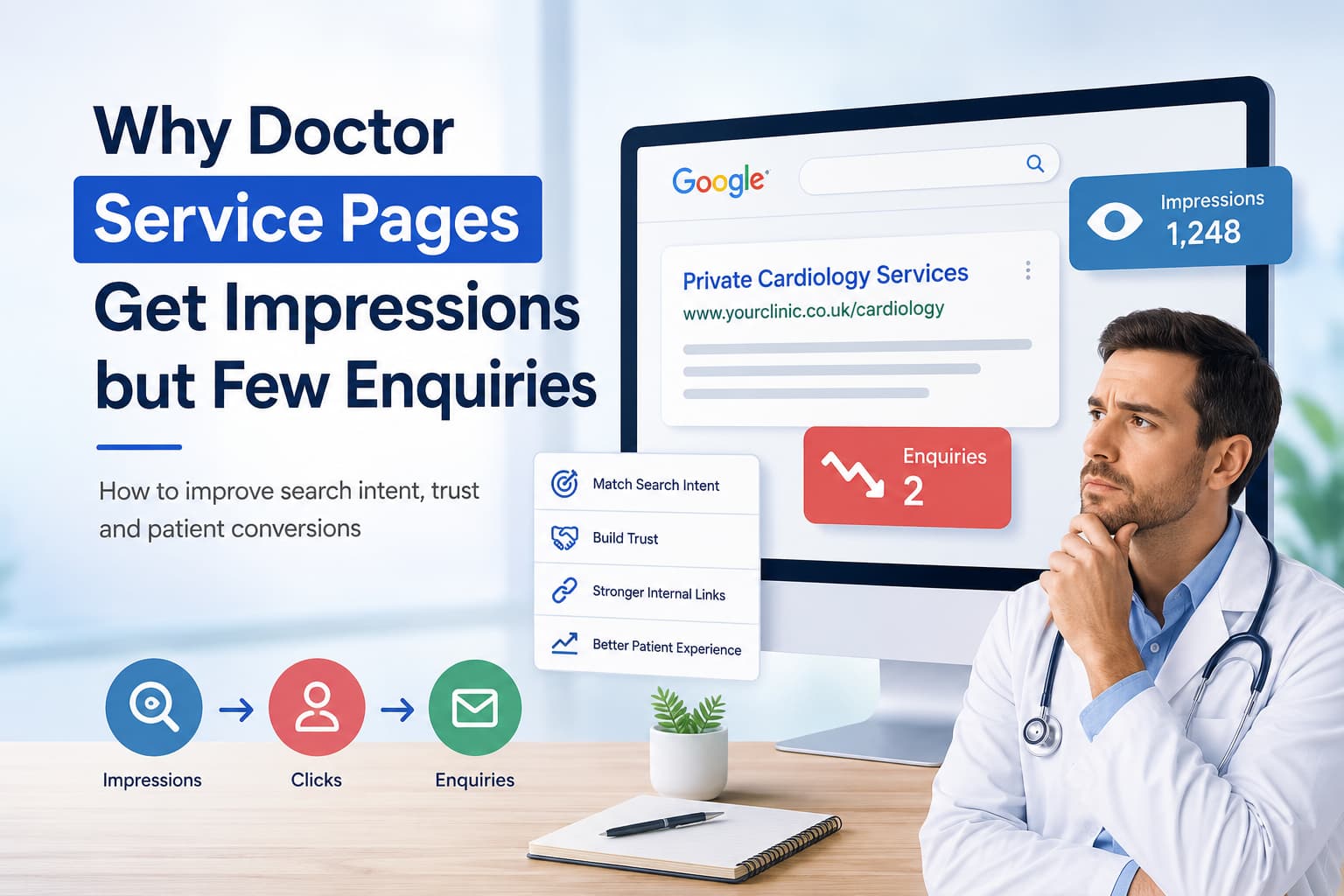
Doctor service pages can appear in Google Search Console, receive impressions and still generate very few enquiries.
That usually does not mean the page is completely failing.
It often means Google understands the topic well enough to test the page, but the page is not yet strong enough to earn consistent clicks or persuade patients to take the next step.
The gap normally sits between three areas:
- search intent
- page quality
- enquiry experience
A doctor service page must do more than mention a treatment or medical service. It needs to match what patients are searching for, answer the right questions and make the next action clear.
What Impressions Actually Mean
An impression is recorded when a page appears in a Google search result.
It does not necessarily mean:
- the page ranked near the top
- the user noticed the result
- the title was attractive
- the searcher was ready to enquire
- the page matched the query closely
A page can receive hundreds of impressions from positions where very few people click.
For example, a doctor service page may appear for related queries on pages five, six or seven. Google recognises the subject, but the page is still not competitive enough to earn meaningful traffic.
This is why impressions should be treated as a visibility signal rather than a final result.
When a page already receives impressions, the opportunity is often to improve and clarify it instead of replacing it.
The Page Is Ranking for the Wrong Searches
One common reason for low enquiries is that the service page appears for informational searches rather than treatment-seeking searches.
A page about private cardiology may receive impressions for searches such as:
- what does a cardiologist do
- common heart symptoms
- types of heart tests
- when to see a heart specialist
These searches are relevant, but many users may only be researching.
The same page may struggle to rank for more valuable searches such as:
- private cardiologist near me
- cardiology consultation
- heart specialist appointment
- private heart clinic
The content needs to support both understanding and action, but the commercial intent must remain clear.
A strong doctor service page should explain:
- what the service is
- who it may be suitable for
- which symptoms or concerns may lead someone to seek help
- what the consultation process involves
- where the service is available
- how to make an enquiry
Without this structure, Google may interpret the page as general information rather than a service page.
The Title Does Not Encourage Clicks
A page can appear in search results but still receive very few clicks because its title is vague or generic.
Titles such as:
- Our Services
- Specialist Care
- Medical Treatments
- Private Healthcare Services
do not tell patients enough.
A stronger title usually combines:
- the service
- the type of provider
- the location where relevant
- a clear patient benefit or next step
For example:
Private Dermatology Consultations in Manchester
is clearer than:
Dermatology Services
The first title immediately tells the patient what is offered and where.
The meta description also matters. It should not simply repeat the title. It should explain what the patient can expect and encourage a relevant action without making exaggerated claims.
For example:
“Book a private dermatology consultation for assessment of ongoing skin concerns, with clear information about appointments, treatment options and next steps.”
The objective is not to make the result sound promotional. It is to make it relevant and useful.
The Page Is Too Thin
Many doctor service pages contain only a few paragraphs.
They may include:
- a short service description
- a list of conditions
- a contact button
- a doctor photograph
That may not be enough for competitive medical searches.
Patients usually want more information before making an enquiry, especially when the service involves personal health concerns, private fees or specialist treatment.
A useful service page may need to cover:
- who the service is for
- symptoms or concerns commonly assessed
- what happens during the first consultation
- tests or assessments that may be discussed
- treatment pathways
- appointment format
- clinic location
- consultant information
- fees or pricing guidance
- referral requirements
- frequently asked questions
This does not mean adding unnecessary medical detail.
The aim is to answer the practical questions that stop patients from taking action.
A specialist SEO for doctors strategy should strengthen service pages around patient intent rather than simply increasing word count.
The Page Tries to Cover Too Many Services
Another problem appears when one page attempts to rank for several different treatments or specialties.
For example, a single page may list:
- dermatology
- cardiology
- women’s health
- diagnostics
- minor surgery
- general consultations
This creates a weak search signal because the page does not have one clear purpose.
Patients searching for a specific service are also less likely to feel that the page directly answers their needs.
A better structure is usually:
- one main specialty page
- separate pages for major treatments or consultations
- clinician profile pages
- relevant location pages
- supporting informational articles
A general services page can act as a hub, but it should not replace detailed treatment pages.
The more specific the patient need, the more specific the landing page usually needs to be.
The Doctor Profile Is Missing or Disconnected
Medical decisions are strongly influenced by trust.
A patient may understand the service but still hesitate because the page does not clearly show who will provide the care.
Doctor service pages should connect naturally to relevant clinician profiles.
A useful doctor profile may include:
- full professional name
- qualifications
- specialty
- registrations
- clinical interests
- experience
- hospital or clinic affiliations where appropriate
- consultation locations
- profile photograph
- link to book or enquire
The service page should also link back to the relevant doctor profile.
This creates a clearer relationship between:
- the service
- the provider
- the clinic
- the enquiry path
When service pages and doctor profiles are disconnected, patients may need to search the website manually for basic information.
That friction can reduce enquiries.
The Page Does Not Show Local Relevance
Doctor service pages often need a clear local context.
A patient may search for a private specialist in a city, town or nearby area. If the page does not explain where consultations take place, Google and the user may both struggle to understand its local relevance.
Local signals can include:
- clinic address
- service area
- nearby areas served
- directions
- parking or transport information
- consultation availability
- embedded map
- consistent contact details
- local internal links
Location information should be practical, not repetitive.
Avoid forcing the city name into every paragraph. A clear heading, clinic details and naturally written location information are usually more useful than keyword repetition.
For broader visibility, a doctor service page should also connect with the clinic’s Google Business Profile and other consistent business information.
The Page Has Weak Internal Links
A service page may receive impressions but remain weak because it is isolated within the website.
Important doctor service pages should receive internal links from:
- the homepage
- the main services hub
- related specialties
- doctor profile pages
- relevant blogs
- location pages
- FAQs where appropriate
Internal links help search engines understand which pages are important and how topics relate to one another.
They also help patients move from general information to a specific service.
For example, an article about symptoms that may require specialist assessment should link naturally to the relevant service page.
The anchor should describe the destination clearly.
Examples include:
- private cardiology consultation
- dermatology assessment
- specialist doctor appointment
- treatment information for patients
Avoid repeatedly using the exact same anchor text across every page.
A natural internal-link structure is more useful than aggressive keyword repetition.
The Enquiry Path Is Unclear
Even a well-ranked page can fail if patients do not know what to do next.
Common problems include:
- no clear call to action
- contact button only at the bottom
- unclear phone number
- long enquiry form
- no indication of response time
- no information about referrals
- no booking guidance
- mobile buttons that are difficult to use
The page should make the next step obvious.
Possible actions include:
- request an appointment
- call the clinic
- send an enquiry
- check consultation availability
- ask about fees
- book an initial assessment
The correct action depends on how the clinic operates.
The call to action should also appear at natural points throughout the page, not only after a long block of content.
Patients should not have to search for a way to contact the clinic.
The Page Does Not Address Practical Patient Concerns
Patients often hesitate because important information is missing.
The service page may explain the treatment but fail to answer practical questions such as:
- Do I need a GP referral?
- How much does the consultation cost?
- Is the service available privately?
- How long is the appointment?
- Can I book online?
- Which clinic location provides the service?
- Will I see a consultant?
- What should I bring?
- Are follow-up appointments available?
These details may be more important to enquiry conversion than adding another long section about the treatment itself.
A doctor service page should reduce uncertainty.
The easier it is for the patient to understand the process, the easier it is to take the next step.
The Content Sounds Generic
Generic medical content can reduce both ranking potential and trust.
Phrases such as:
- we provide high-quality care
- our experienced team is here to help
- patient satisfaction is our priority
- we offer personalised treatment
are common across thousands of healthcare websites.
These statements are not automatically wrong, but they do not explain what makes the service useful.
Stronger content is specific.
It may explain:
- which consultation is offered
- who delivers it
- what happens during the appointment
- which concerns are commonly assessed
- where the clinic is located
- how the patient can enquire
Specific information gives both Google and patients more reason to understand the page.
The Page Has Technical Problems
Sometimes the content is suitable, but technical issues reduce performance.
Possible problems include:
- slow loading
- poor mobile usability
- broken contact buttons
- incorrect canonical tags
- duplicate URLs
- weak page titles
- missing internal links
- accidental noindex tags
- important content loaded incorrectly
- pages excluded from the sitemap
- structured data errors
A medical website SEO audit by Medical SEO Agency can help determine whether the main limitation comes from content, technical setup, internal linking or search intent.
Technical checks are especially important when a page receives impressions but does not improve over time.
The Page Does Not Match the Search Result Competition
A doctor service page may also struggle because competing pages provide a stronger overall experience.
Competitors may offer:
- clearer service explanations
- named consultants
- stronger location information
- fees
- FAQs
- appointment guidance
- better internal links
- more authoritative supporting content
- stronger backlinks
The solution is not to copy competitors.
Instead, identify which useful information their pages provide that yours does not.
Then improve the page around the needs of your own patients and services.
How to Improve a Doctor Service Page
Start with the page that already receives impressions.
Review:
- Which queries trigger the page?
- Are those queries informational or commercial?
- Does the title match the strongest relevant query?
- Is the service explained clearly?
- Is the doctor or consultant identified?
- Is the clinic location obvious?
- Are practical questions answered?
- Is the enquiry path visible?
- Does the page receive internal links?
- Does it compete with another page on the site?
This review will usually reveal whether the page needs:
- a better title
- stronger content
- clearer service intent
- improved internal links
- a better call to action
- consolidation with another page
- more local information
- technical corrections
The right improvement depends on the actual weakness.
Impressions Are an Opportunity
A doctor service page receiving impressions is not necessarily a failed page.
It means Google has already found some relevance.
The objective is to strengthen that signal and make the page more useful to patients.
The most effective improvements usually come from:
- matching patient search intent
- making the service more specific
- connecting the service with the doctor
- answering practical concerns
- strengthening internal links
- improving titles and descriptions
- simplifying the enquiry journey
More impressions only become valuable when the page also earns clicks and gives patients enough confidence to make contact.
A well-structured doctor SEO strategy should therefore measure more than ranking positions. It should examine how search visibility connects to service-page quality, patient understanding and meaningful enquiries.