

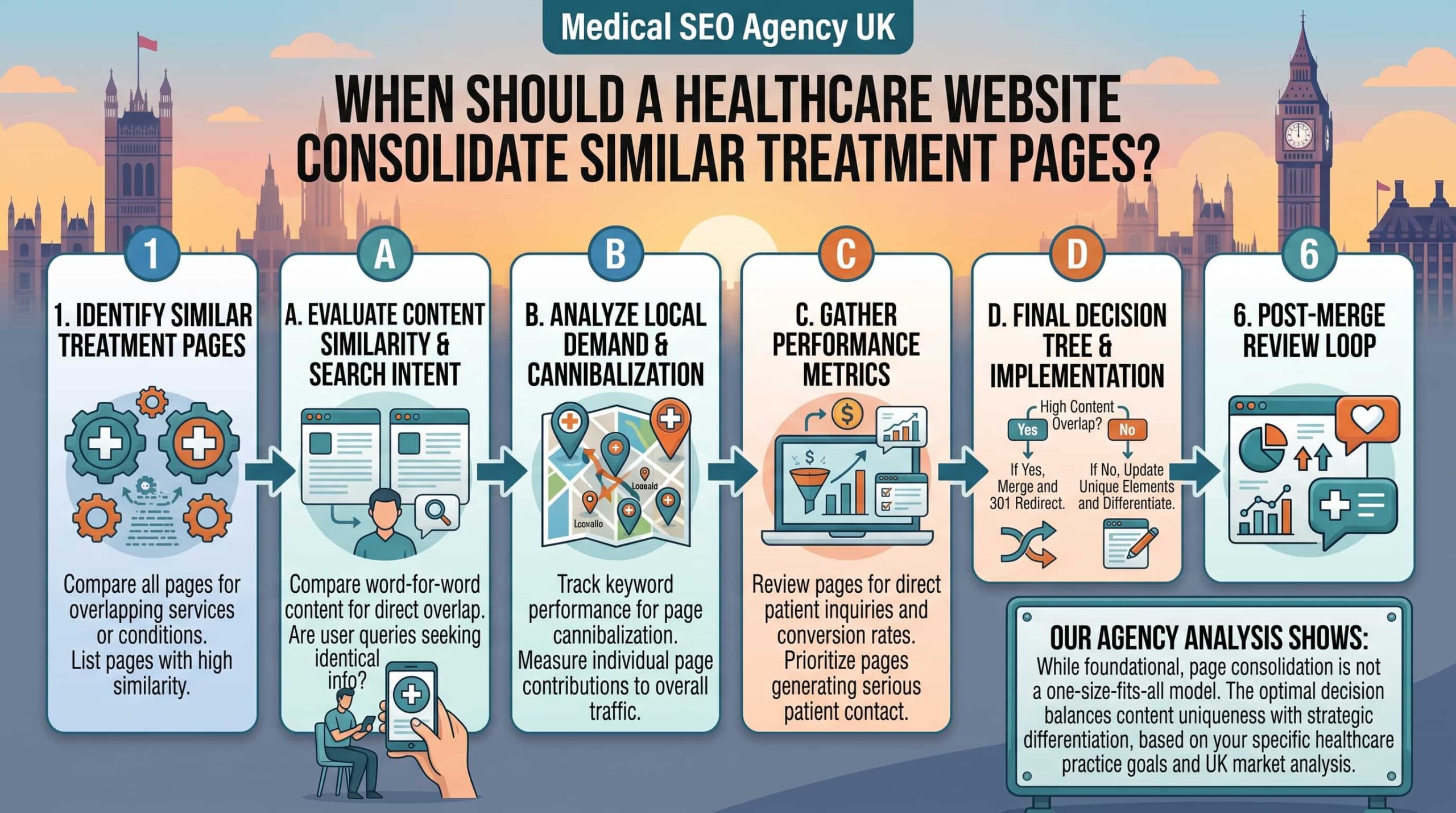
Medical content consolidation should be considered when multiple treatment pages answer substantially the same patient question, target the same search intent and describe services that patients would reasonably view as one offering.
However, similar terminology does not automatically mean pages should be merged. Two treatments may share keywords while differing in clinical purpose, eligibility, procedure, practitioner, location or patient decision process.
The correct decision requires both search-performance evidence and clinical review. A healthcare organisation should determine whether the pages genuinely compete, whether each page serves a distinct patient need and whether consolidating them would make the care pathway clearer.
Direct Answer
A healthcare website should consider consolidating similar treatment pages when:
- The pages target the same patient intent
- They describe substantially the same treatment or service
- Their content repeats the same eligibility, process and outcome information
- The same queries cause different URLs to appear
- Google regularly changes which page ranks
- Neither page performs strongly enough to justify remaining separate
- Internal links point inconsistently between them
- Patients are unlikely to understand the difference
- One comprehensive page would provide a clearer decision resource
- One page is outdated and adds no distinct clinical value
The pages should normally remain separate when they represent:
- Clinically distinct treatments
- Different conditions or treatment purposes
- Different patient eligibility requirements
- Different risks, recovery processes or expected outcomes
- Separate specialties
- Distinct consultation or referral pathways
- Different physical locations with genuine local information
- Different audiences requiring materially different guidance
- Separate search intents
- Meaningfully different patient decisions
The objective is not to reduce page quantity. It is to give every indexable page a clear and useful purpose.
What Is Medical Content Consolidation?
Medical content consolidation is the process of combining overlapping healthcare content into a stronger primary page and removing or repositioning unnecessary competing URLs.
The process may include:
- Selecting the page that should remain
- Identifying useful information across the overlapping pages
- Reviewing the combined content for clinical accuracy
- Moving valuable information to the preferred page
- Removing repetition
- Redirecting retired URLs
- Updating internal links
- Updating the sitemap and canonical signals
- Monitoring search and patient behaviour after implementation
Consolidation should improve clarity for patients as well as search engines.
Medical SEO Agency helps healthcare organisations assess how treatment, clinician and location content should fit together. Our healthcare search strategy focuses on creating clear page ownership without removing clinically useful distinctions.
Why Healthcare Websites Develop Similar Treatment Pages
Overlap often develops gradually rather than through a deliberate decision.
Common causes include:
- Different teams publishing without a shared content map
- A new treatment name replacing an older term
- Separate campaigns creating new landing pages
- Pages being built around individual keyword variations
- Different clinicians requesting pages for related services
- Acquisitions bringing several websites or page structures together
- Location pages repeating the complete treatment description
- Blog articles being written for queries already owned by service pages
- Old pages remaining live after services change
- A website redesign retaining legacy URLs
- Agencies adding pages without reviewing existing content
For example, a clinic might have separate pages titled:
- Joint injection treatment
- Steroid injections
- Corticosteroid injections
- Joint pain injections
- Injection treatment for arthritis
These pages may represent distinct purposes, or they may describe the same core service using different search language. The titles alone are not enough to decide.
A clinical reviewer must first confirm whether the pages describe the same intervention, different applications of that intervention or genuinely separate services.
Similar Keywords Do Not Always Mean Duplicate Intent
Keyword overlap is evidence to investigate, not proof that consolidation is required.
Consider two pages covering:
- Laser treatment for acne
- Laser treatment for acne scarring
Both may contain terms related to laser treatment and acne, but patients are making different decisions. One concerns active acne, while the other concerns residual scarring.
Combining them could make the resulting page less precise.
Likewise:
- Initial fertility consultation
- Fertility testing
- IVF treatment
- Fertility preservation
These subjects belong within the same patient journey but do not necessarily satisfy the same intent.
Each page may deserve to remain separate if it provides:
- A distinct clinical purpose
- Unique eligibility information
- Different preparation requirements
- Different risks or limitations
- A separate appointment pathway
- Sufficient useful information
- A clearly defined relationship with the other pages
The decision must examine the patient need behind the search, not merely the shared words.
Signs That Treatment Pages May Be Competing
Several signals can indicate that similar pages require review.
Different URLs appear for the same queries
Search Console may show that several treatment pages receive impressions for similar query groups.
This does not automatically mean harmful cannibalisation. Google can display different pages when they offer different value.
Concern becomes more justified when:
- The intended page does not appear consistently
- Google frequently changes the ranking URL
- A weaker or outdated page replaces the preferred page
- Both pages remain at weak positions
- Their content and intent are substantially the same
- There is no clear reason for both to exist
Rankings switch repeatedly between pages
If one page ranks for a treatment query during one period and another replaces it during the next, the website may not be sending a clear ownership signal.
Before merging, check whether the change relates to:
- Device
- Location
- query wording
- Branded versus non-branded searches
- Search intent
- A recent page update
- Technical canonicalisation
- Internal links
- Temporary ranking fluctuations
URL switching matters most when the pages are genuinely interchangeable.
The pages repeat most of the same content
Treatment pages may use slightly different introductions but repeat:
- What the treatment is
- Who may be suitable
- How the procedure works
- Preparation
- Risks
- Recovery
- Results
- Fees
- Frequently asked questions
- Calls to action
If the distinguishing information occupies only a few sentences, separate pages may not be helping patients.
The organisation should consider whether a single comprehensive page with clearly labelled sections would communicate the options more effectively.
Patients cannot understand the distinction
A page structure should reflect decisions patients can understand.
Potential signs of confusion include:
- Similar page titles
- Unexplained clinical terminology
- Two pages offering the same appointment
- Identical clinician and location details
- Repeated calls to action
- No comparison between the treatments
- No explanation of which pathway applies
- Similar information appearing in different navigation sections
If internal teams cannot explain the difference between two pages in one or two clear sentences, patients may also struggle.
Internal links are inconsistent
Internal links can reveal unclear page ownership.
One article may link to one treatment page while another article links to a different page using nearly identical anchor text. Clinician profiles may alternate between the two URLs, and navigation may favour neither.
This can make it difficult to establish which page is the primary treatment resource.
When Treatment Pages Should Remain Separate
Consolidation should not remove information patients need to make safe and informed decisions.
The treatments are clinically distinct
Pages should normally remain separate when treatments differ materially in:
- Clinical purpose
- Mechanism
- Eligibility
- Contraindications
- Preparation
- Procedure
- Risks
- Recovery
- Expected outcomes
- Follow-up care
Even if the treatments address the same condition, patients may need separate explanations.
The pages satisfy different search intents
A condition page and treatment page may contain some overlapping information but serve different purposes.
For example:
- “What causes varicose veins?” seeks condition information
- “Varicose vein treatment” seeks treatment options
- “Endovenous laser treatment” seeks a specific procedure
- “Varicose vein specialist London” seeks a provider
These pages can coexist when each has a clear role and connects patients to the appropriate next step.
This is particularly important for fertility providers. IVF, fertility testing, fertility preservation and initial consultations may form part of one patient journey, but they can represent different treatment needs and search intents. Our guide to SEO for fertility clinics explains how these services can be organised around relevant patient searches.
The patient groups are materially different
Separate pages may be justified when guidance differs for:
- Adults and children
- Pregnant patients
- Athletes
- Patients with particular underlying conditions
- NHS and private pathways
- Self-referral and clinician-referral pathways
- Domestic and international patients
The distinction should be medically and operationally genuine—not created solely to target extra keywords.
Different specialists provide the treatment
Separate pages may be useful when related procedures belong to different specialties or require different referral pathways.
However, separate clinician profiles should not replace the need for a clear primary treatment page. Clinician information should support the treatment pathway by explaining who provides the care.
Locations provide genuinely different services
Location pages may remain separate when they contain unique information such as:
- Treatments available at that site
- Clinicians practising there
- Appointment availability
- Diagnostic facilities
- Accessibility
- Referral arrangements
- Transport and parking information
- Local contact details
Changing only the town name does not create a useful distinct page.
A clear relationship among services, clinicians and locations is part of an effective healthcare website structure.
A Medical Content Consolidation Decision Framework
Each pair or group of similar pages can be evaluated using the following framework.
| Question | Keep separate when | Consider consolidating when |
|---|---|---|
| Do the pages satisfy different intents? | Patients seek different answers | The intended answer is substantially the same |
| Are the treatments clinically distinct? | Procedure, suitability or risks differ materially | Pages describe the same service using different terminology |
| Do patients face different decisions? | Each page supports a separate care decision | Both pages lead to the same decision and appointment |
| Is the content substantially unique? | Each page contains necessary, specific guidance | Most sections repeat the same information |
| Do different queries lead to each page? | Query groups are clearly distinguishable | The same query group triggers both pages |
| Does each page perform independently? | Both attract relevant visibility and patient actions | Visibility is weak, divided or unstable |
| Are different clinicians or locations involved? | This materially changes the care pathway | Provider details are the only meaningful difference |
| Could one page remain useful without the other? | Each is complete within its own purpose | One page adds little beyond the other |
| Would merging reduce patient clarity? | Combining creates an overly broad or confusing page | One page would present the information more clearly |
| Can the difference be explained simply? | The distinction is clear and clinically meaningful | The difference depends mainly on keyword wording |
The decision should not depend on only one row. Clinical purpose, patient intent and performance evidence should be considered together.
How to Use Search Console in the Decision
Search Console can help identify overlap at the query and page level.
For each potentially competing page, review:
- Queries producing impressions
- Clicks
- Average positions
- Click-through rates
- Countries
- Devices
- Trends over an appropriate period
- Which URL appears for priority searches
Create groups of queries representing the same broad patient intent. Then compare which pages appear for those groups.
Ask:
- Does one page consistently outperform the others?
- Does Google appear to prefer a different page from the one intended?
- Are different pages visible for meaningfully different searches?
- Is one page attracting irrelevant queries?
- Did visibility change after a page was added or updated?
- Does either page generate patient actions?
- Are the differences caused by geography or device rather than overlap?
Search Console data has limitations. Average position is not a fixed ranking, and not every query is reported. It should be combined with page content, analytics, internal-link data and clinical review.
How to Choose the Page That Should Remain
When consolidation is appropriate, the strongest page is not always the newest or the one with the preferred URL.
Evaluate each candidate according to:
- Clinical accuracy
- Search intent
- Existing relevant clicks and impressions
- Backlinks
- Internal links
- Patient actions
- URL clarity
- Content completeness
- Historic performance
- Inclusion in navigation
- Alignment with the current service
- Ease of maintaining accurate information
The surviving page should provide the best long-term home for the treatment.
If the strongest-performing URL has an outdated slug but otherwise serves the correct purpose, retaining it may be preferable to changing URLs unnecessarily.
If another URL is substantially clearer and strategically appropriate, migration may still be justified. The organisation should then map and redirect the old URLs carefully.
What Information Should Be Preserved?
Consolidation should not mean copying every paragraph into one oversized page.
Before combining content, identify information that is:
- Clinically necessary
- Unique
- Current
- Useful for patient decisions
- Supported by appropriate expertise
- Consistent with the service provided
- Required for referral or appointment preparation
Potentially valuable sections include:
- Treatment options
- Eligibility
- Reasons a treatment may not be suitable
- What happens during consultation
- Preparation
- Procedure
- Risks and limitations
- Recovery
- Follow-up
- Fees and funding
- Clinicians
- Locations
- Referral requirements
- Questions patients frequently ask
Remove:
- Repetition
- Outdated service information
- Unsupported promotional claims
- Keyword-focused filler
- Conflicting medical statements
- Duplicate biographies
- Generic information that does not help the patient
- Calls to action for unavailable services
The combined page should undergo clinical and editorial review before publication.
Google recommends producing helpful, reliable content primarily for people rather than content created to manipulate rankings. This is particularly important for medical subjects, where inaccurate or unclear information can affect significant decisions. Google’s people-first content guidance
Alternatives to Full Consolidation
Merging and redirecting is not the only available option.
Reposition one page
A treatment page may overlap because its purpose is unclear.
It could be repositioned as:
- A condition guide
- A treatment comparison
- A preparation guide
- A recovery guide
- A clinician-reviewed FAQ
- An eligibility explanation
- A referral guide
This is appropriate only when the revised page serves a genuine and distinct patient need.
Create a treatment hub
Several clinically distinct treatments for the same condition may benefit from a broader comparison page.
The hub could explain:
- Available options
- Important differences
- Factors affecting suitability
- Which specialists provide them
- Where they are available
- How assessment works
The individual treatment pages can then provide detailed information.
Improve internal differentiation
Pages may remain separate but require clearer:
- Titles
- H1 headings
- Introductions
- Internal anchors
- Calls to action
- Page ownership
- Navigation labels
- Cross-links
Each page should explain how it differs from related treatments.
Apply a canonical only to genuine duplicates
A canonical element can indicate the preferred URL among duplicate or very similar versions, but it should not replace proper content decisions.
Google describes canonicalisation as selecting the representative URL from a group of duplicate pages. It also treats canonical declarations as signals rather than absolute instructions. Google’s canonical URL guidance
If a page should no longer be available to users, consolidating its useful content and applying a permanent redirect is generally clearer than leaving it accessible with a canonical pointing elsewhere.
How to Implement a Treatment-Page Consolidation
1. Create a complete URL inventory
Record:
- Every overlapping URL
- Title
- H1
- Page purpose
- Intended query group
- Search performance
- Organic actions
- Backlinks
- Internal links
- Canonical URL
- Indexing status
- Clinical owner
- Proposed action
Do not rely only on pages visible in the main navigation. Legacy and campaign pages may still be indexable.
2. Confirm the clinical relationship
A qualified clinical reviewer should establish:
- Whether the treatments are the same
- Whether terminology has changed
- Whether patient groups differ
- Whether risks and eligibility differ
- Whether the pages should be combined
- Which information must remain
- Which statements are outdated
SEO similarity cannot determine clinical equivalence.
3. Select the preferred page
Choose the surviving URL using clinical purpose, search evidence, usability and long-term maintainability.
Document why it was selected.
4. Build the consolidated content
Move only valuable and accurate material into the surviving page.
Ensure it has:
- One clear purpose
- A descriptive title and H1
- A direct explanation
- Appropriate clinical review
- Clear treatment distinctions
- Relevant clinician and location pathways
- Suitable calls to action
- A visible review process where appropriate
5. Apply permanent redirects
Each retired URL should redirect directly to the most relevant surviving page.
Google recommends permanent server-side redirects when a URL has permanently moved. The 301 and 308 status codes communicate that permanent change. Google’s redirect guidance
Avoid:
- Redirect chains
- Sending every retired page to the homepage
- Redirecting to an unrelated treatment
- Leaving old pages returning a normal 200 status
- Using temporary redirects for a permanent consolidation
- Redirecting before the combined page is ready
6. Update internal links
Change internal links so they point directly to the surviving URL.
Review links from:
- Navigation
- Treatment hubs
- Condition pages
- Clinician profiles
- Location pages
- Blog articles
- Frequently asked questions
- Footer links
- XML and HTML sitemaps
Do not rely on redirects to handle internal navigation permanently.
7. Check technical signals
Confirm that:
- The surviving page has a self-referencing canonical
- Retired URLs redirect correctly
- The sitemap contains only the preferred URL
- No important internal links point to retired pages
- The page is indexable
- Structured data remains accurate
- Navigation points to the preferred page
- Tracking continues to work
8. Monitor the result
After implementation, monitor:
- Indexing
- Preferred canonical selection
- Relevant impressions
- Clicks
- Query ownership
- Organic landing-page visits
- Patient actions
- Redirect errors
- Search visibility for important treatment terms
Consolidation may produce short-term fluctuations while search engines process the changes. It should be evaluated over an appropriate period rather than reversed after a few days.
When Pages Should Be Removed Without Consolidation
Some pages may provide no information worth preserving.
Removal may be appropriate when a page:
- Describes a service no longer offered
- Contains inaccurate medical information
- Was created only for an expired campaign
- Has no useful unique content
- Duplicates another page completely
- Targets a location where care is not available
- Makes claims the organisation cannot support
- Should not have been publicly indexed
- Creates a misleading patient pathway
The correct technical treatment depends on whether there is a relevant replacement.
If there is a closely equivalent page, use an appropriate permanent redirect. If there is no relevant replacement, returning a genuine 404 or 410 response may be clearer than redirecting patients to an unrelated page.
How Consolidation Affects Patient-Demand Measurement
Before merging pages, record baseline performance for each URL.
After consolidation, compare the combined performance of the retired and surviving URLs against the new primary page.
Measure:
- Relevant query coverage
- Impressions
- Clicks
- Landing-page traffic
- Appointment actions
- Qualified enquiries
- Bookings
- Geographic relevance
- Patient navigation
- Organic conversions by treatment
Do not compare the surviving page only with its own previous traffic. It may inherit the role previously divided among several URLs.
The wider purpose is to determine whether appropriate patients are reaching a clearer treatment pathway. Our guide to healthcare SEO measurement explains how to connect search visibility with enquiries, bookings and attended appointments.
Common Medical Content Consolidation Mistakes
Healthcare organisations should avoid:
- Merging pages solely because they share keywords
- Making consolidation decisions without clinical review
- Removing distinct eligibility or safety information
- Combining unrelated treatments into a generic page
- Redirecting every retired URL to the homepage
- Keeping conflicting medical statements
- Publishing an excessively broad combined page
- Forgetting clinician and location links
- Leaving retired URLs in the sitemap
- Keeping internal links pointed at redirects
- Using canonical tags where permanent redirects are required
- Measuring only keyword rankings afterwards
- Removing content without preserving a record
- Assuming every case of URL switching is cannibalisation
- Creating new replacement pages before understanding the existing overlap
Consolidation should simplify the patient journey, not merely reduce the number of URLs.
Questions to Ask Before Merging Treatment Pages
Before approving consolidation, ask:
- Do these pages describe the same clinical service?
- What patient question does each page answer?
- Are the intended search queries materially different?
- Would patients understand why both pages exist?
- Are eligibility, risks, preparation or recovery different?
- Do the pages lead to different appointments?
- Do different clinicians or locations affect the pathway?
- Which page currently performs best?
- Does either page have valuable backlinks?
- Which information must be preserved?
- Who will review the combined medical content?
- Which URL should remain?
- Which URLs require permanent redirects?
- Which internal links must be updated?
- How will patient and search performance be measured afterwards?
If these questions cannot be answered confidently, the consolidation should not proceed yet.
Final Answer
A healthcare website should consolidate similar treatment pages when they describe substantially the same service, satisfy the same patient intent and repeat information without providing a meaningful clinical or navigational distinction.
Pages should remain separate when they support different:
- Treatments
- Conditions
- Patient groups
- Eligibility requirements
- Risks
- Recovery processes
- Specialists
- Locations
- Referral pathways
- Search intents
- Patient decisions
The decision should combine clinical review with search-performance data, website analytics and patient-pathway analysis.
When consolidation is appropriate, the organisation should select the strongest long-term page, preserve accurate and useful information, redirect retired URLs, update internal links and monitor the result.
Healthcare providers requiring support with content inventories, keyword ownership, redirects and treatment-page structure can review our medical SEO services.
Effective medical content consolidation does not aim to create the fewest possible pages. It aims to ensure that each remaining page has a clear purpose, supports informed patient decisions and leads users towards the correct care pathway.
You may also find useful: Why Doctor Service Pages Receive Impressions but Few Enquiries · Who Should Review Medical SEO Content Before It Is Published?
Related services: SEO for Hair Transplant Clinics