


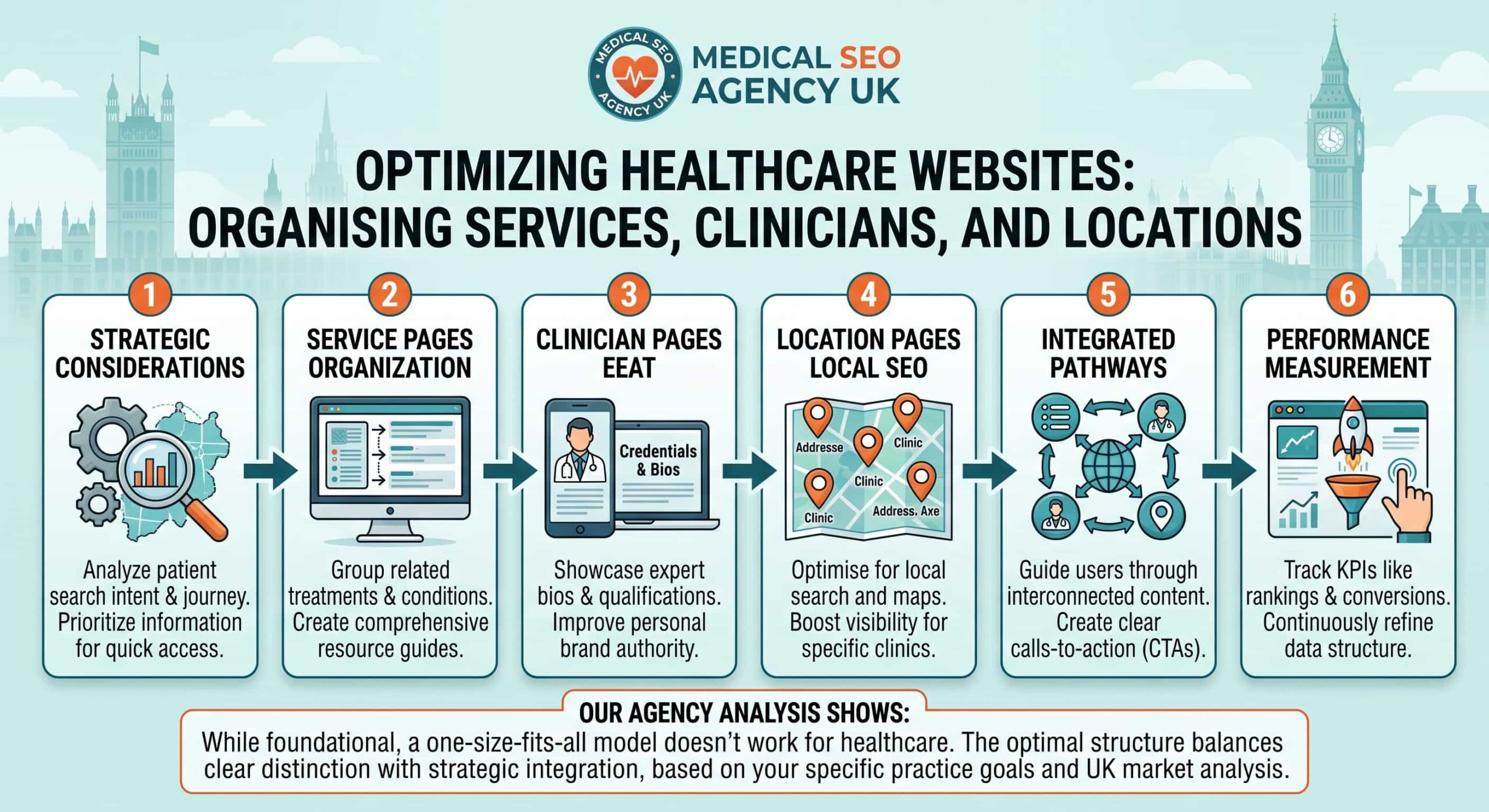
A healthcare website should normally organise its content around three distinct questions:
- What care or treatment does the organisation provide?
- Who provides that care?
- Where can the patient receive it?
Service pages should answer the first question, clinician profiles should answer the second, and location pages should answer the third. These page types should support one another rather than repeat the same information or compete for the same search.
The correct structure depends on the organisation. A single-location clinic with two doctors needs fewer pages than a healthcare group operating several clinics with dozens of clinicians. The aim is not to create the largest possible website. It is to give each useful page a clear patient purpose.
Direct Answer
Healthcare organisations should create separate pages for services, clinicians and locations when each page represents information that patients may reasonably search for or need before making an enquiry.
A clear healthcare website structure usually looks like this:
| Page type | Primary purpose | Typical patient question |
|---|---|---|
| Service or treatment page | Explain a specific form of care | What does the clinic provide? |
| Clinician profile | Establish who provides the care | Who will assess or treat me? |
| Location page | Explain where care is available | Where can I receive the service? |
| Condition page | Explain a problem that may lead to treatment | Can this clinic help with my condition? |
| Information article | Answer an early-stage patient question | What should I know before deciding? |
Every page should have its own main purpose. If two pages provide substantially the same answer to the same patient, the website may need consolidation rather than another URL.
Why Healthcare Website Structure Matters
Patients do not always begin with the name of a treatment. One person may search for a symptom, another for a specialist, and another for a clinic near their home or workplace.
A useful healthcare website structure connects these different starting points.
For example, a patient researching knee pain might move through the website in this order:
- Knee pain information page
- Musculoskeletal assessment service
- Physiotherapist profile
- Clinic location
- Appointment or enquiry page
Search engines also need accessible links between important pages. Google recommends making important pages reachable through crawlable links and using descriptive anchor text that helps people and search engines understand the destination.
The structure should therefore support patient navigation and technical discoverability at the same time.
What Belongs on a Healthcare Service Page?
A service page should focus on one identifiable service, treatment or area of care.
Depending on the service, the page may explain:
- Who the service may be suitable for
- The problems or needs it addresses
- What an assessment may involve
- The available treatment or care pathway
- Who provides the service
- Where the service is available
- Relevant qualifications or governance information
- Pricing or funding information where appropriate
- How to enquire, book or obtain a referral
The service page should not become a collection of every keyword related to the topic. It should help a patient understand the service and decide on an appropriate next step.
When Should a Service Have Its Own Page?
Create a separate service page when most of the following are true:
- The organisation genuinely provides the service
- Patients may search for it independently
- It has its own eligibility, assessment or treatment information
- It is available through one or more identifiable clinicians
- It can support a useful enquiry or booking action
- The clinic can provide enough original information to justify the page
Do not create a separate page merely because a keyword tool shows another phrase. Several phrases may describe the same service and belong on one comprehensive page.
What Belongs on a Clinician Profile?
A clinician profile should help a patient understand who the practitioner is, what they do and how their experience relates to the care being considered.
For private doctors and consultants, our SEO services for doctors connect practitioner profiles with relevant treatment pages, genuine practice locations and clear appointment routes.
A useful profile may include:
- Full professional name
- Current role
- Professional registration information
- Qualifications
- Specialty or clinical interests
- Services provided
- Conditions commonly assessed
- Locations and availability
- Languages spoken where relevant
- Professional memberships
- Research, publications or teaching where applicable
- A clear route to enquire or book
The General Medical Council maintains public registers that allow people to check a doctor’s registration status and other professional information.
A website should present credentials accurately. It should not imply qualifications, specialties or outcomes that cannot be verified.
Should Every Clinician Have a Separate Profile?
A separate profile is usually appropriate when the clinician is patient-facing and patients can choose, research or book with that person.
A separate profile may be unnecessary when:
- The person has no patient-facing role
- There is not enough useful information to create a meaningful page
- The profile would contain only a name and job title
- The organisation cannot keep the information accurate
Thin profiles created only to target names or locations can make the website harder to maintain without helping patients.
What Belongs on a Healthcare Location Page?
A location page should represent a genuine place where the organisation provides care or manages an eligible service.
It may include:
- Clinic name
- Complete address
- Telephone number
- Opening or appointment hours
- Services available at that location
- Clinicians practising there
- Transport, parking and accessibility information
- Photographs of the actual clinic
- Map and directions
- Registration or provider information where relevant
- A location-specific enquiry or booking route
The Care Quality Commission explains that a location may be a place where regulated activity is delivered and may itself represent a service, such as a care home or dental service.
Healthcare providers should make sure their website terminology is consistent with their genuine operating and registration arrangements.
When Should Each Clinic Have Its Own Page?
Create a separate location page when:
- Patients can genuinely attend that location
- The address and contact information can be verified
- The available clinicians or services differ meaningfully
- The page can provide location-specific information
- The organisation can keep the page updated
Do not create pages for virtual offices, borrowed addresses or areas where the organisation has no genuine patient-facing presence.
How Should Services, Clinicians and Locations Connect?
The website should connect these entities through useful internal links.
From a Service Page
Link to:
- Clinicians who provide the service
- Locations where the service is available
- Closely related conditions or patient guidance
- The most appropriate enquiry route
From a Clinician Profile
Link to:
- Services provided by that clinician
- Genuine practice locations
- Relevant professional information
- The correct booking or enquiry process
From a Location Page
Link to:
- Services available at that location
- Clinicians practising there
- Transport and accessibility information
- Location-specific contact or booking options
These links should be descriptive. An anchor such as “knee assessment service” communicates more than a generic phrase such as “learn more”.
A Decision Framework for Creating Separate Pages
Use the following framework before creating a new URL.
| Question | If yes | If no |
|---|---|---|
| Does the page represent a real service, clinician or location? | Continue the assessment | Do not create it |
| Does it satisfy a distinct patient need? | Define that need clearly | Consider combining it with an existing page |
| Is there enough original information? | Develop the page | Expand an existing page instead |
| Can the information be maintained accurately? | Assign an owner and review schedule | Do not publish an unstable page |
| Does it have a clear relationship with other pages? | Add contextual internal links | Reconsider where it belongs |
| Does it offer an appropriate next step? | Add the relevant action | Clarify the page’s purpose |
Passing every test does not automatically mean that a new page is necessary. The final decision should consider whether an existing page already satisfies the same intent.
Example Structure for a Single-Location Clinic
A focused clinic website might use:
- Homepage
- Services overview
- Service A
- Service B
- Service C
- Conditions overview
- Condition A
- Condition B
- Clinicians
- Clinician A
- Clinician B
- About the clinic
- Fees or insurance information
- Patient information
- Contact and location
The location information may remain on the contact page if the clinic operates from only one site and there is no separate location-search requirement.
Example Structure for a Multi-Location Healthcare Group
A larger organisation might use:
- Homepage
- Services
- Individual service pages
- Conditions
- Individual condition pages
- Clinicians
- Individual clinician profiles
- Locations
- Individual clinic pages
- Patient information
- Referrer information
- About and governance
- Contact or central booking
The organisation should avoid generating every possible service and location combination automatically.
A page titled “Service A in Location B” should exist only when it provides meaningful information beyond the main service page and location page.
Should Services Be Repeated Across Location Pages?
Location pages should identify the services available there, but they should not copy complete service-page content.
A practical division is:
- The service page provides the complete explanation of the care
- The location page confirms local availability and practical attendance information
- The clinician page explains who delivers the care
The location page can summarise a service and link to the full service page. This keeps the information useful without producing several near-identical treatment descriptions.
How Should Articles Fit Into the Structure?
Articles should answer informational questions and guide readers towards the most relevant permanent page.
For example:
- An article about preparing for an assessment links to the service page
- An article explaining a clinician’s specialty links to the profile where useful
- An article about attending the clinic links to the genuine location page
Articles should not replace core service pages. A clinic that only publishes blogs may gain visibility for questions without clearly explaining the care it provides.
Specialist services should therefore have a dedicated page where patients can understand the available treatments, clinicians and locations. For example, effective fertility clinic SEO should connect fertility-related searches with the appropriate treatment and appointment pages.
The NHS digital service manual recommends using a clear page hierarchy and provides navigation patterns for helping users move between related health pages. Healthcare organisations should also establish a defined process for creating, reviewing and updating health information.
Common Healthcare Website Structure Problems
One General Services Page
Patients cannot find sufficient information about individual services, and search engines have no focused page to associate with each service.
A Separate Page for Every Keyword Variation
Several pages answer the same question with lightly rewritten content. The organisation then struggles to decide which page should be updated or linked.
Clinician Profiles With No Service Links
The profile establishes who the clinician is but does not help the patient understand what care they provide.
Location Pages With Copied Text
Each location page repeats the same service descriptions and changes only the place name.
Articles Disconnected From Patient Services
The website publishes useful information but provides no clear pathway from research to a relevant service, clinician or location.
Important Pages Hidden in Search or Dropdown Tools
Patients and search-engine crawlers may struggle to reach pages that are not linked through the website’s main structure.
How to Review an Existing Healthcare Website
Create a spreadsheet containing every indexable URL and classify each page as:
- Service
- Condition
- Clinician
- Location
- Article
- Organisation or governance
- Transactional page
- Utility page
For each URL, record:
- Its primary patient question
- The page type
- Intended next step
- Related service, clinician and location
- Internal links received
- Internal links provided
- Whether similar content exists elsewhere
- Content owner
- Last clinical or organisational review date
Pages with no clear question, owner or relationship to the wider structure should be reviewed.
The correct action may be improvement, consolidation, redirection or removal, depending on the page’s value and available evidence.
When Specialist Support May Be Appropriate
Complex healthcare websites often require coordination between clinical stakeholders, content owners, developers and search specialists.
Organisations that need help mapping patient searches to appropriate services, clinicians and locations can consider working with a specialist team like ours.
The purpose should be to create a maintainable structure based on real services and patient needs, not to manufacture pages for every possible keyword.
Final Checklist
Before publishing or restructuring pages, confirm that:
- Every service page represents care the organisation genuinely provides
- Every clinician profile contains accurate, maintainable information
- Every location page represents a real patient-facing location
- Each page has one clear primary purpose
- Similar pages do not repeat the same answer
- Services link to relevant clinicians and locations
- Clinicians link to their genuine services and locations
- Location pages identify what is actually available there
- Informational articles lead to useful permanent pages
- Important pages are reachable through crawlable links
- Navigation labels are clear to patients
- Every page has an appropriate next step
- Clinical and organisational information has a review process
Final Thoughts
A useful healthcare website structure does not begin with page quantity. It begins with the relationship between patients, services, clinicians and genuine places of care.
Service pages explain what is provided. Clinician profiles explain who provides it. Location pages explain where it is available. Conditions and articles help patients enter the structure from earlier informational searches.
When those page types have distinct purposes and connect through clear internal links, the website becomes easier to navigate, maintain and understand.
You may also find useful: Doctor Website Page Structure: Should Every Doctor, Treatment and Location Have a Separate Page? · When Should a Healthcare Website Consolidate Similar Treatment Pages?
Related services: SEO for Hospitals · SEO for Dentists