

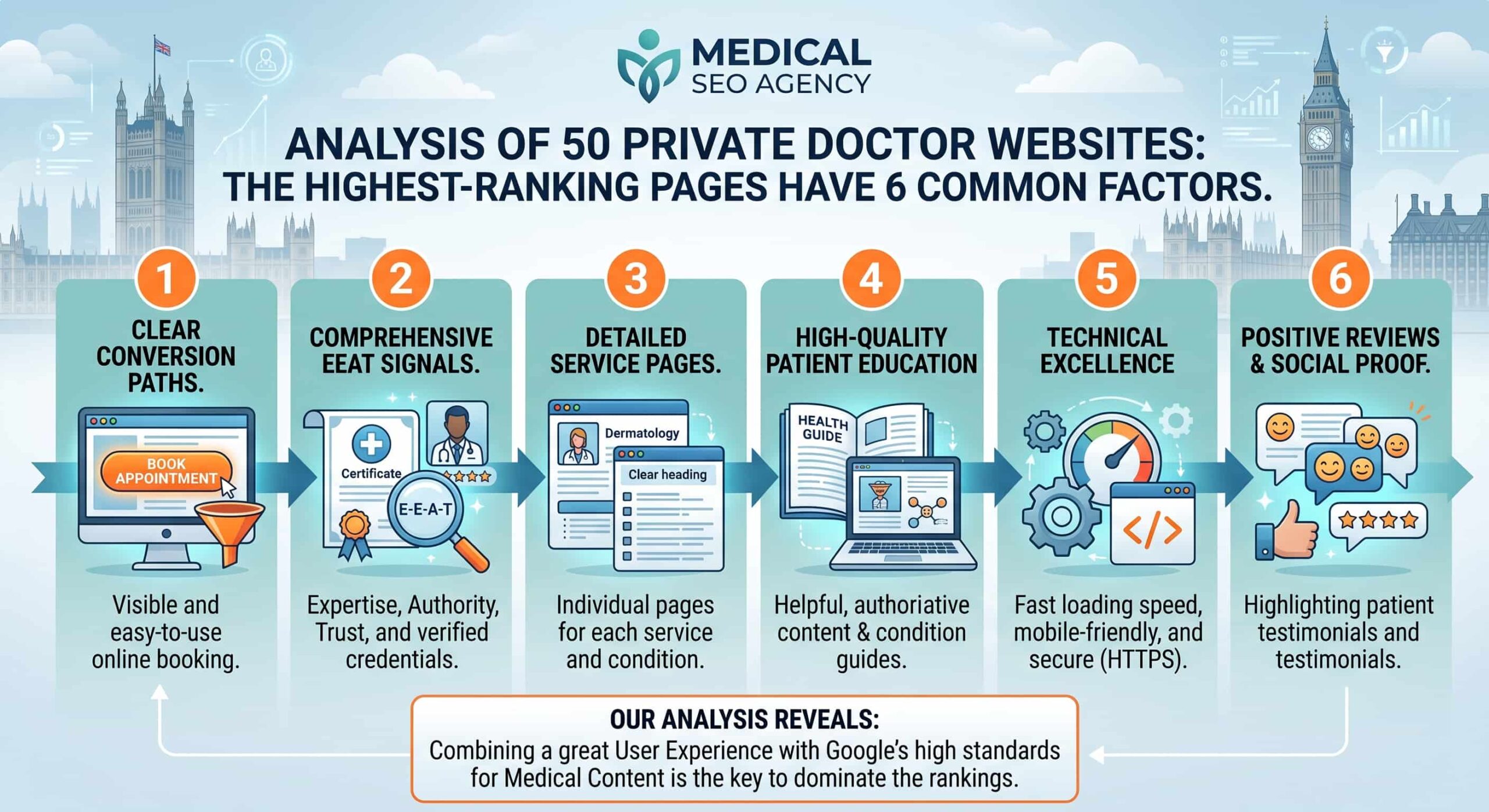
The private doctor pages appearing prominently in our sample did not rely on one universal template. However, they repeatedly made four things clear: which patients they served, which conditions they assessed, who provided the care and how a patient could arrange an appointment.
We reviewed 50 private doctor and specialist clinic pages appearing prominently across ten London-based specialty searches. The sample included individual consultants, specialist practices, private hospitals and consultant-led clinics.
The purpose was not to declare individual elements as confirmed Google ranking factors. It was to identify recurring page characteristics that private practices can compare with their own websites.
The Short Answer
The strongest pages commonly combined:
- A clearly defined specialty and location
- Dedicated information about conditions and treatments
- Visible consultant or clinician profiles
- Verifiable qualifications and professional affiliations
- A direct appointment or enquiry route
- Specific clinic and location information
- Clear explanations of what happens next
- Internal links connecting clinicians, conditions and treatments
Pricing, insurance information, patient reviews, FAQs and medically reviewed content appeared less consistently. These elements may still help patients make decisions, but they were not present across every ranking page we reviewed.
How We Conducted the Review
The review was completed in August 2026.
We examined five prominent organic provider pages for each of these searches:
- Private cardiologist London
- Private dermatologist London
- Private gastroenterologist London
- Private gynaecologist London
- Private neurologist London
- Private endocrinologist London
- Private rheumatologist London
- Private ENT consultant London
- Private psychiatrist London
- Private orthopaedic surgeon London
We excluded:
- Paid advertisements
- General editorial articles
- News results
- Pure doctor directories
- NHS information pages without a private-service pathway
- Pages unrelated to booking private specialist care
The final sample contained a mixture of individual consultant websites, specialist clinics and private hospital specialty pages.
For each result, we reviewed the visible landing page and connected site structure for evidence of:
- Specialty and location relevance
- Conditions and symptoms
- Treatments and diagnostic services
- Consultant profiles
- Credentials and professional registration
- Appointment routes
- Clinic locations
- Pricing or insurance information
- Reviews and patient stories
- Educational resources
- Internal links
- Authorship and medical review information
The findings represent an observational content and website-structure review. They do not prove that any feature directly caused a page to rank.
Search results can also vary by location, device, personalisation and date. A London sample should not automatically be treated as representative of every UK private healthcare market.
What the Ranking Pages Had in Common
| Page characteristic | How frequently it appeared | Likely patient benefit |
|---|---|---|
| Clear specialty and location | Almost universal | Confirms immediate relevance |
| Conditions or symptoms covered | Almost universal | Helps patients recognise whether the service fits their concern |
| Appointment or enquiry route | Almost universal | Provides an obvious next step |
| Named consultants or clinicians | Common | Shows who will provide the care |
| Treatment or diagnostic information | Common | Explains what the provider can offer |
| Clinic location details | Common | Helps patients assess accessibility |
| Credentials and affiliations | Common | Supports verification and trust |
| Pricing or insurance information | Mixed | Helps patients assess affordability |
| Reviews or patient stories | Mixed | Provides evidence of patient experience |
| Educational content | Mixed | Supports earlier patient research |
| Medical reviewer or review date | Inconsistent | Helps readers assess clinical accountability |
| FAQs | Inconsistent | Answers practical questions before enquiry |
The most important finding was not that every site contained every element. It was that the stronger pages reduced uncertainty at several stages of the patient journey.
1. The Page Immediately Established Specialty and Location
Prominent pages generally made their specialty obvious through the title, heading, opening paragraph or navigation.
A patient arriving from Google could usually determine:
- The medical specialty
- Whether the service was private
- The geographic location
- Whether the provider treated adults, children or both
- Whether the page represented one consultant or a clinical team
For example, One Heart Clinic identifies its cardiology focus, London locations, consultants and appointment options without requiring the visitor to search through a general hospital website.
The Welbeck dermatology page similarly establishes the specialty, consultant-led care model and contact route near the beginning of the page.
This clarity matters because private healthcare searches often combine three types of intent:
- Specialty
- Location
- Access to care
A page that discusses healthcare generally may not adequately answer a search for a specific private specialist.
Practical implication
The main heading and opening section should identify the actual service rather than beginning with generic statements about excellence, innovation or patient care.
A private cardiologist page, for example, should make cardiology, private access and location clear before introducing broader brand messaging.
2. Conditions and Symptoms Were Given Prominent Space
Most ranking pages did more than name a specialty. They explained which conditions, symptoms or patient concerns the service addressed.
Examples included:
- Chest pain, palpitations and breathlessness
- Acne, eczema, psoriasis and suspicious moles
- Reflux, inflammatory bowel disease and digestive symptoms
- Pelvic pain, menopause and menstrual problems
- Migraine, epilepsy and movement disorders
- Thyroid, diabetes and hormone conditions
- Joint pain, arthritis and autoimmune conditions
- Hearing, sinus, throat and balance problems
- Anxiety, depression and ADHD
- Knee, shoulder, hip and spinal problems
The Devonshire Clinic connects its main dermatology page with detailed condition and treatment pages, including acne, eczema, psoriasis, skin cancer, mole checks and surgical procedures.
The London Heart Clinic separates conditions from treatments while linking both pathways from its main page.
Why this structure helps patients
Patients do not always begin with the name of a specialty. They may search by:
- Symptom
- Suspected condition
- Diagnostic test
- Treatment
- Type of specialist
A doctor website built only around a biography and a general services page may miss several parts of this search journey.
Practical implication
A doctor website should determine whether important conditions and treatments need:
- Their own pages
- Sections on a broader specialty page
- Links from the consultant profile
- Supporting patient articles
Not every medical term requires a separate URL. The decision should depend on patient intent, the service actually provided and whether the website can offer sufficiently useful information.
3. Consultant Identity Was a Central Part of the Page
Named consultants were a common feature across the sample.
The stronger implementations did more than display a photograph and job title. They connected the clinician with:
- Specialty
- Areas of clinical interest
- Qualifications
- Current hospital appointments
- Professional registration
- Research or publications
- Treatments provided
- Clinic locations
- Appointment availability
The Devonshire Clinic consultant section connects multiple dermatologists with their specialist interests and professional backgrounds.
Individual consultant websites could go further. The site for Dr Charis Costopoulos includes clinical interests, professional profiles, registration information, publication history and named medical review details.
Patients can independently verify a UK doctor’s registration through the General Medical Council register. Linking to a verifiable register entry can be more useful than making unsupported statements about expertise.
Practical implication
A doctor profile should answer:
- Who is the doctor?
- What do they specialise in?
- Which patients and conditions do they see?
- Where do they practise?
- What qualifications and registrations can be verified?
- How can a patient request an appointment?
For a more detailed structure, see our guide to doctor profile page SEO.
4. Conditions, Treatments and Doctors Were Connected
The strongest websites did not treat the specialty page, consultant profiles and treatment information as isolated sections.
They created visible routes such as:
Specialty → Condition → Treatment → Consultant → Appointment
A patient reading about atrial fibrillation could move to available treatments, identify the relevant cardiologist and then request an appointment.
A patient reviewing a mole-check service could find the dermatologists providing it, understand the procedure and view the clinic location.
This structure was especially visible on larger specialist clinic and hospital websites.
Practical implication
Internal linking should reflect real clinical and patient relationships.
Useful connections include:
- Condition page to relevant treatment
- Treatment page to consultant
- Consultant profile to conditions treated
- Clinic page to available specialists
- Educational article to appropriate service
- Service page to appointment information
Internal links should not be added only to distribute SEO authority. They should help a patient move towards the information or service they need.
5. Appointment Routes Were Difficult to Miss
Prominent pages usually provided a clear next action.
Common options included:
- Book an appointment
- Request a callback
- Make an enquiry
- Find a consultant
- Call the clinic
- Submit a referral
- Contact the medical secretary
One Heart Clinic provides separate routes for appointments, consultant selection, referrals and condition information.
Welbeck places consultant selection and enquiry options close to the main description of the service.
What weaker pages often get wrong
A page can receive impressions and visits but still generate few enquiries when:
- The appointment option appears only in the footer
- The contact form is generic
- Telephone details are difficult to find on mobile
- The page does not explain whether self-referral is allowed
- Patients cannot tell which consultant they need
- There is no indication of the next step
- The service information is too broad
A call to action cannot compensate for missing clinical information. It works best after the page has helped the patient understand whether the provider is appropriate.
6. Location Information Was Specific
Location was rarely treated as an incidental footer detail.
Ranking providers commonly identified:
- Clinic name
- Street or area
- City
- Telephone number
- Available consultants
- Services offered at that location
- Appointment availability
- Directions or maps
Multi-location providers often created dedicated location pages rather than listing every address in one paragraph.
This is important because a patient may be choosing between:
- A consultant near home
- A Harley Street appointment
- A hospital with specific diagnostic facilities
- An online consultation
- A clinic covered by their insurer
Practical implication
Do not create location pages by changing only the place name.
A useful clinic page should explain what is genuinely available at that location, including consultants, services, facilities, contact details and access information.
7. Trust Was Demonstrated Through Specific Evidence
Trust language appeared widely, but the stronger pages supported it with identifiable evidence.
Examples included:
- Consultant qualifications
- NHS appointments
- Professional registration
- Specialist interests
- Publications
- Named hospitals
- CQC information
- Patient stories
- Reviews
- Awards with a named awarding body
- Clinical review dates
- Clear contact information
Google advises publishers to provide clear sourcing, authorship and evidence of expertise, particularly for health-related topics where trust is especially important. Its guidance also makes clear that E-E-A-T is not a single ranking factor that can be added to a page as a checklist. It is a useful way to assess whether content appears reliable and accountable. See Google’s guidance on helpful, reliable content.
For regulated services in England, patients may also be able to check provider information through the Care Quality Commission.
Practical implication
Replace vague claims such as “leading”, “world-class” or “the best” with evidence a patient can inspect.
That might include:
- A GMC register link
- A named consultant appointment
- A recognised qualification
- A published research profile
- A specific clinical interest
- A CQC profile
- A transparent patient-feedback source
8. Pricing and Insurance Information Were Useful but Inconsistent
Pricing was not present on every ranking page.
Some providers published:
- Initial consultation prices
- Follow-up prices
- Diagnostic test fees
- Treatment packages
- Self-pay information
- Accepted insurers
Others asked patients to contact the clinic.
The Dr Francesco Lo Monaco cardiology site displays prices for several diagnostic services. The Medical Chambers ENT page states a starting consultation price and explains the appointment route.
Practical implication
Where prices can be stated accurately, they may reduce uncertainty and unsuitable enquiries.
If a fixed price cannot be provided, explain:
- What affects the cost
- Whether a referral is required
- Whether insurance is accepted
- Whether tests are charged separately
- How patients can request an estimate
Pricing information should be reviewed regularly and carry a visible review date.
9. Educational Content Worked Best When Connected to Care
Some ranking websites maintained substantial patient information libraries. Others ranked with comparatively little blog content.
The difference was not simply publishing frequency.
Educational content was most useful when it connected questions and symptoms with relevant clinical pages. A cardiology article about palpitations, for example, could link to:
- Arrhythmia information
- Diagnostic tests
- Relevant consultants
- Appointment options
Google’s current guidance encourages original, useful material rather than content produced at scale merely to capture search variations. It specifically recommends non-commodity information that provides experience, research or analysis beyond what any publisher could easily reproduce. See Google’s guidance for content appearing in AI search features.
Practical implication
A private doctor website does not need hundreds of generic medical articles.
It needs a clear relationship between:
- Patient questions
- Conditions
- Treatments
- Clinicians
- Locations
- Appointments
10. FAQs Were Helpful but Not Essential
FAQs appeared on some pages but were not universal.
Useful questions included:
- Do I need a GP referral?
- Can I use private medical insurance?
- How much does a consultation cost?
- What should I bring?
- Can I book online?
- Are remote appointments available?
- Which consultant should I choose?
- What happens after the consultation?
The value came from answering genuine patient concerns, not from adding FAQ schema or repeating keywords.
Practical implication
Use information gathered from:
- Reception teams
- Medical secretaries
- Enquiry forms
- Patient emails
- Consultation preparation
- Search Console
- Internal site search
These sources are more useful than generating a generic list of questions with no connection to the practice.
What Was Not Consistent Across the Ranking Pages?
Several commonly recommended SEO elements were not present across every result:
- Long-form copy
- Large FAQ sections
- Published prices
- Patient testimonials
- A blog
- Review schema
- Exact-match headings
- Multiple location pages
- A named medical reviewer
- Extensive structured data
This does not mean these elements lack value.
It means no isolated feature should be treated as a guaranteed private doctor website ranking factor.
Different pages may rank because of different combinations of relevance, authority, brand recognition, website structure, links, location and patient usefulness.
A Practical Private Doctor Page Framework
A strong private doctor or specialty page can be organised around the following structure:
1. Immediate service identification
State the specialty, location, intended patients and appointment route.
2. Patient concerns
Explain the symptoms, conditions or reasons someone might seek the service.
3. Clinical services
Describe relevant consultations, investigations and treatments.
4. Consultant information
Identify the doctors providing the service and link to detailed profiles.
5. Patient pathway
Explain what happens before, during and after an appointment.
6. Location and access
Provide clinic details, contact options, directions and availability.
7. Pricing and insurance
State prices where possible or explain how costs are determined.
8. Verifiable trust evidence
Include qualifications, registration, professional roles and accountable review information.
9. Clear next step
Give patients an appropriate booking, callback or enquiry route.
Private Doctor Website Review Checklist
Use this checklist to assess an existing page:
- Is the specialty clear from the main heading?
- Is the clinic location visible?
- Does the page explain who the service is for?
- Are important symptoms or conditions covered?
- Are treatments and diagnostic services explained?
- Are relevant consultants named?
- Do profile links work?
- Can qualifications and registration be verified?
- Is the appointment process clear?
- Are prices or insurance arrangements explained?
- Can mobile visitors call or enquire easily?
- Do educational articles link to services?
- Do service pages link to the appropriate doctor?
- Is the content clinically reviewed where necessary?
- Is the review date visible?
- Are unsupported superiority claims removed?
- Does each important page have a distinct search purpose?
- Can a patient understand what to do next?
What This Means for Private Doctors
The study does not support the idea that private doctors need to publish as much content as large hospital groups.
It supports a more focused conclusion:
A private doctor website should build clear, connected evidence around the clinician, the patient’s concern, the service provided, the clinic location and the appointment pathway.
An individual consultant can compete with a larger provider when the website offers a more precise answer to a specific patient search.
That may require:
- A stronger consultant profile
- Separate pages for major services
- Clear condition coverage
- Better internal linking
- Verifiable credentials
- More useful appointment information
- Focused location relevance
- Fewer generic articles
Our SEO services for doctors focus on connecting these elements around real patient search behaviour rather than publishing disconnected content.
For practices needing broader support, Medical SEO Agency provides specialist medical SEO guidance covering website structure, technical visibility, service pages, internal linking and patient enquiry pathways.
Study Limitations
This review has several limitations:
- It examined London-focused searches only.
- Search results can vary by user, location, device and date.
- The sample included individual doctors, clinics and private hospitals.
- The review assessed visible website characteristics, not confidential performance data.
- It did not measure backlinks, conversion rates or patient outcomes.
- It identified correlation and recurring patterns, not direct causation.
- A feature appearing on a ranking page is not automatically a Google ranking factor.
The study should therefore be used as a website-planning reference, not a guaranteed ranking formula.
Final Findings
The private doctor pages in our sample most consistently succeeded at removing uncertainty.
They told patients:
- What the specialty was
- Which problems were assessed
- Which treatments were available
- Who would provide the care
- Where appointments took place
- How to take the next step
The strongest pages connected those answers rather than presenting them as isolated pieces of content.
Private doctor website SEO is therefore not simply about using a target keyword or publishing more medical articles. It is about creating a clear relationship between patient intent, clinical expertise, service information, location and access to care.