

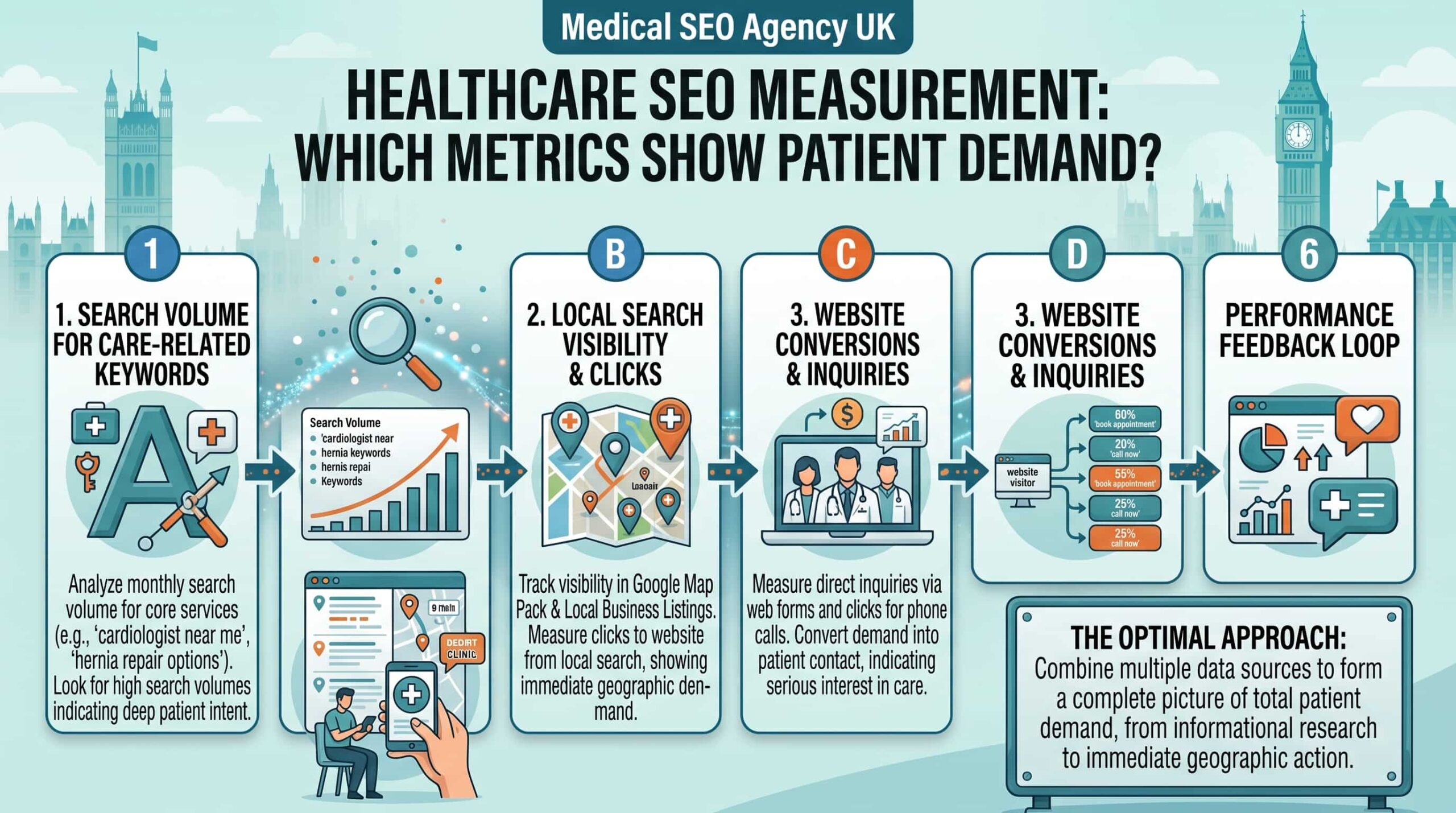
Healthcare SEO measurement should distinguish general online visibility from genuine patient demand. Rankings, impressions and website traffic can show whether a healthcare provider is becoming easier to find, but they do not prove that more prospective patients want or are able to use its services.
Stronger demand indicators include searches for relevant treatments in genuine service areas, visits to appropriate service and clinician pages, appointment actions, qualified enquiries and completed bookings.
No single metric provides the complete answer. Healthcare organisations need a measurement model connecting search visibility with patient behaviour while respecting privacy, consent and clinical appropriateness.
Direct Answer
The healthcare SEO metrics most likely to indicate patient demand are:
- Impressions for relevant condition, treatment and provider searches
- Non-branded clicks to important service pages
- Organic visits from genuine service areas
- Appointment-page visits
- Online booking starts and completions
- Click-to-call actions
- Contact and referral-form submissions
- Directions and location-page interactions
- New-patient enquiries attributed to organic search
- Qualified bookings for the promoted service
- Attended appointments originating from organic search
- Demand by treatment, clinician and location
- Changes in enquiry-to-booking and booking-to-attendance rates
Rankings, total impressions, traffic and engagement remain useful diagnostic metrics. However, they become meaningful indicators of patient demand only when they relate to appropriate searches, services, locations and patient actions.
Medical SEO Agency helps healthcare organisations connect organic search visibility with meaningful patient actions. Learn more about our specialist healthcare SEO strategy for clinics, doctors and healthcare providers.
What Is Healthcare SEO Measurement?
Healthcare SEO measurement is the process of evaluating whether organic search activity is helping prospective patients find suitable information and take appropriate next steps.
This involves more than recording keyword positions.
A useful measurement system should show:
- Whether the organisation appears for relevant searches
- Whether searchers select its pages
- Whether they find the appropriate service, clinician or location
- Whether they take an enquiry or appointment action
- Whether those actions become qualified bookings
- Whether booked patients attend
- Whether the resulting demand matches available services and capacity
These stages should be examined together.
A clinic may gain more traffic without gaining more patients. Another provider may experience modest traffic growth while receiving substantially more relevant enquiries because the additional visitors are reaching high-intent service pages.
Why Traffic Alone Does Not Measure Patient Demand
Organic traffic shows that people arrived from search engines. It does not explain why they searched or whether they could become patients.
Traffic may come from:
- Students researching medical subjects
- Healthcare professionals seeking clinical information
- People outside the provider’s service area
- Patients looking for NHS rather than private care
- Searches for services the organisation does not provide
- Existing patients looking for contact information
- Job seekers
- Suppliers
- Researchers
- People seeking general health information
- Prospective patients comparing providers
All these visits may appear in an organic traffic report, but they have different commercial and operational value.
Traffic should therefore be segmented by:
- Search intent
- Landing-page type
- Service
- Location
- New or returning visitor status
- Relevant patient action
- Enquiry quality
- Booking outcome
A rise in traffic to a general informational article may improve awareness without indicating immediate patient demand. A smaller rise in traffic to a treatment page may be a stronger signal if it produces suitable enquiries.
Build a Patient-Demand Measurement Funnel
Healthcare organisations can structure measurement across five levels.
| Measurement level | Main question | Example metrics |
|---|---|---|
| Search demand | Are people searching for relevant care? | Relevant impressions, query themes, location demand |
| Search visibility | Can they find the organisation? | Rankings, search-result coverage, clicks, CTR |
| Service interest | Do they investigate suitable care? | Service-page visits, clinician-page visits, location-page visits |
| Patient action | Do they take a meaningful next step? | Calls, forms, booking starts, referral actions |
| Patient outcome | Does the action become genuine demand? | Qualified enquiries, bookings, attendance, treatment acceptance |
The further a metric moves down this funnel, the closer it usually comes to actual patient demand.
However, lower-funnel metrics often require information from several systems. Search Console may show search visibility, analytics may show website actions, and a booking or patient-management system may show whether an enquiry became an appointment.
1. Relevant Non-Branded Search Impressions
An impression occurs when a result from the website appears in Google Search.
Healthcare organisations should separate branded searches from non-branded searches.
Branded searches
These may include:
- The clinic’s name
- A clinician’s name
- A hospital or group name
- A branded treatment programme
- Misspellings of the organisation’s name
Branded visibility is important, but much of this demand may already exist. The searcher knows the provider and is trying to find it.
Non-branded searches
These may include:
- A treatment near the searcher
- A type of specialist
- A condition and treatment option
- A clinician specialty in a particular city
- The cost of a private procedure
- Waiting-time or availability questions
- A diagnostic service
- A comparison between suitable treatments
Growth in relevant non-branded impressions can indicate that the organisation is becoming visible to people who have not yet selected a provider.
Google Search Console allows performance to be examined by queries, pages, countries and other dimensions. These reports can help identify which search themes are producing visibility. Google’s Search Console guidance
Impressions should still be interpreted carefully. Visibility for irrelevant educational searches or locations outside the provider’s reach may increase the total without representing usable demand.
2. Search Intent by Query Theme
Individual keywords can fluctuate and may be hidden or difficult to interpret at scale. Grouping searches by intent produces a clearer picture.
Useful healthcare query groups include:
Condition awareness
Examples include searches about symptoms, possible causes and when to seek help.
These searches may indicate an early need, but they do not necessarily represent immediate demand for a particular provider.
Treatment research
These searches concern available treatments, suitability, recovery, risks, outcomes and alternatives.
They may indicate that the searcher is considering care but still needs information.
Provider selection
These searches include specialties, clinics, hospitals, doctors, availability, reviews, accreditations and locations.
They generally sit closer to a provider decision.
Appointment intent
These may concern booking, consultation availability, waiting times, referral requirements, fees or immediate access.
They are often stronger demand indicators because the searcher is investigating how to receive care.
Navigational intent
These searches contain the organisation’s, clinician’s or location’s name.
They show existing awareness and should be reported separately from new non-branded discovery.
The measurement model should track changes across these groups instead of combining every query into one visibility number.
3. Clicks to Relevant Service Pages
A search impression indicates visibility. A click shows that the searcher selected the provider’s result.
Google explains that clicks and click-through rate help show whether people choose a website from the search results. Changes should be investigated at the individual query and page level rather than judged only through sitewide totals. Google Search Console and Analytics guidance
Clicks are more meaningful when the landing page relates to a service the organisation genuinely provides.
Relevant landing pages may include:
- Treatment pages
- Condition-and-treatment pathways
- Specialty pages
- Clinician profiles
- Clinic or hospital location pages
- Diagnostic-service pages
- Appointment-information pages
- Pricing or funding pages
A rise in clicks to these pages can suggest increasing service interest.
Clicks to unrelated informational articles may still be valuable for education and awareness, but they should not automatically be reported as patient acquisition.
4. Organic Traffic by Service Line
Healthcare organisations should divide organic performance by service rather than reporting only the total.
For example:
| Service line | Organic visits | Enquiries | Bookings | Attended appointments |
|---|---|---|---|---|
| Dermatology | 1,200 | 42 | 25 | 21 |
| Physiotherapy | 850 | 61 | 47 | 39 |
| Diagnostics | 600 | 18 | 12 | 11 |
| Fertility care | 400 | 24 | 15 | 13 |
These figures are illustrative, but they demonstrate why traffic alone can be misleading.
The service receiving the most organic visits may not generate the most bookings. Differences may reflect:
- Search intent
- Treatment urgency
- Price
- Referral requirements
- Appointment availability
- Location
- Patient suitability
- Page quality
- Form complexity
- Telephone handling
- Length of the decision process
Service-level reporting helps the organisation distinguish visibility from operational demand.
5. Geographic Relevance
Patient demand must be evaluated against where the organisation can genuinely provide care.
A clinic with one physical location may receive traffic from across the UK after publishing a widely relevant article. That traffic can improve reach, but it does not necessarily represent realistic appointment demand.
Geographic measurement may consider:
- Town or city
- Region
- Travel distance
- Clinic location
- In-person versus remote service availability
- International-patient eligibility
- Referral boundaries
- Areas where the service is commissioned or available
Location data is not always complete or perfectly accurate, so it should be treated as directional rather than exact.
The organisation should also avoid assuming that every search containing a place name represents a patient located there. Geographic intent should be considered alongside landing pages, enquiries and booking data.
6. Visits to Clinician and Location Pages
A prospective patient may enter through a condition or service page and then investigate:
- Who provides the care
- The clinician’s qualifications
- Areas of expertise
- The clinic location
- Accessibility
- Appointment availability
- Consultation options
- Fees
- Referral requirements
Visits from service pages to relevant clinician or location pages can indicate provider consideration.
Useful measures include:
- Service-to-clinician page journeys
- Service-to-location page journeys
- Clinician-to-booking journeys
- Location-to-contact journeys
- Appointment information views
- Fee and funding information views
These actions should not all be treated as conversions. They are supporting signals showing how prospective patients evaluate a provider.
A clear relationship between services, clinicians and locations also depends on appropriate site architecture. The organisation should ensure that each page type has a distinct role within its healthcare website structure.
7. Appointment and Enquiry Actions
Patient actions sit closer to demand than traffic or rankings.
Examples include:
- Clicking a telephone number
- Submitting an enquiry form
- Starting an online booking
- Completing an online booking
- Requesting a consultation
- Selecting a clinic location
- Viewing directions
- Starting a referral process
- Downloading referral information
- Using an eligibility or suitability checker
- Requesting a callback
In Google Analytics, events representing important business actions can be designated as key events. This allows organisations to evaluate which channels and journeys contributed to those actions. Google Analytics key-event guidance
Not every action should receive equal weight.
A click on a telephone number does not confirm that a call connected. A booking start is weaker than a completed booking. A general contact submission may be unrelated to becoming a patient.
The reporting model should distinguish these actions instead of combining them into a single conversion total.
8. Qualified Patient Enquiries
A completed form or telephone call is not automatically a qualified patient enquiry.
An enquiry may concern:
- A service the organisation does not provide
- NHS care when only private care is available
- An unsuitable age group
- A location the provider cannot serve
- A job application
- A supplier request
- An existing appointment
- An insurance or funding arrangement the provider does not accept
- A clinical situation requiring another care pathway
- A prospective patient who cannot meet referral requirements
A qualified enquiry is one that reasonably matches the service, location and access conditions.
Qualification should be defined with appropriate operational and clinical input. Marketing staff should not make clinical suitability decisions for which they are not responsible.
Possible reporting categories include:
- New-patient enquiry
- Existing-patient administration
- Potentially suitable
- Requires clinical review
- Outside service scope
- Wrong location
- Funding mismatch
- Referral requirement not met
- Non-patient enquiry
This classification provides a more useful demand measure than raw form submissions.
9. Booked Appointments
A booking is usually a stronger patient-demand indicator than an enquiry.
The organisation should measure:
- Bookings attributed to organic search
- Bookings by service
- Bookings by location
- New versus existing patients
- Telephone versus online bookings
- Time from first organic visit to booking
- Enquiry-to-booking rate
- Booking value where appropriate
- Available capacity during the measurement period
Attribution will not always be complete. A patient may discover a provider through organic search, return later through a branded search and finally telephone the clinic.
For this reason, organisations should avoid treating analytics attribution as a perfect record of every patient’s decision journey. It is a measurement model based on observable interactions.
10. Attended Appointments
An appointment booking expresses intent. An attended appointment provides stronger evidence that demand resulted in delivered care.
Useful measures include:
- Attended new-patient appointments
- Attendance rate
- Cancellation rate
- Rescheduling rate
- Non-attendance rate
- Attendance by service and location
- Time between booking and appointment
- Organic-source bookings that reached attendance
A campaign generating many bookings but a low attendance rate may be attracting poorly matched demand or exposing an operational problem.
Possible causes include:
- Long waiting times
- Unclear pricing
- Weak booking confirmation
- Location inconvenience
- Inappropriate enquiries
- Referral misunderstandings
- Patients continuing to compare providers
- Changes in clinical need
SEO cannot control all these factors, but reporting should acknowledge their effect on the outcome.
11. Treatment Acceptance or Appropriate Next Steps
For some healthcare providers, an initial consultation is not the final outcome.
Depending on the service and ethical appropriateness, measurement may continue to:
- Diagnostic appointments
- Clinically appropriate treatment plans
- Treatment acceptance
- Course-of-care starts
- Follow-up attendance
- Referral to another suitable service
These outcomes should never be interpreted solely as sales metrics. Clinical appropriateness, informed consent and patient choice must remain separate from marketing performance.
The purpose is to understand whether organic search is bringing people who can appropriately use the service—not to pressure clinicians or patients towards treatment.
Which SEO Metrics Are Useful but Do Not Prove Patient Demand?
Several common metrics are valuable for diagnosis but weak as standalone demand indicators.
Keyword rankings
Rankings show visibility for selected searches. They do not show:
- The complete search market
- Whether people clicked
- Whether the search was relevant
- Whether the visitor could use the service
- Whether an enquiry occurred
- Whether the patient booked
Rankings should be segmented by intent, service and location.
Total impressions
Impressions can show growing visibility, but they may increase because the website appears for broader informational searches or low-ranking queries.
Relevant impressions matter more than the largest possible impression total.
Total organic traffic
Traffic can include students, clinicians, researchers, existing patients and irrelevant locations.
The landing page and subsequent action determine whether the visit indicates demand.
Click-through rate
CTR can help evaluate search-result performance, but it is influenced by:
- Ranking position
- Branded versus non-branded searches
- Search-result features
- Query intent
- Competitor listings
- The type of page displayed
A low sitewide CTR does not automatically indicate a problem.
Engagement rate and time on page
A person may spend considerable time reading an educational article without needing an appointment. Another patient may find a phone number within seconds and leave to make a call.
Engagement should therefore be interpreted according to the page’s purpose.
Number of pages published
Publishing activity is a deliverable, not a demand metric.
New content becomes meaningful when it:
- Addresses a genuine patient need
- Supports an appropriate service
- Gains relevant visibility
- Helps users navigate
- Contributes to qualified actions
Backlinks and authority metrics
Links can contribute to organic visibility, but they do not directly show patient demand. Third-party authority scores are proprietary estimates rather than measures of patient behaviour.
Separate Leading and Lagging Indicators
Healthcare SEO measurement should include both leading and lagging indicators.
Leading indicators
These can show that visibility or interest is developing:
- Relevant non-branded impressions
- Improved visibility for priority services
- Clicks to service pages
- Geographic relevance
- Visits to clinician and location pages
- Appointment-page visits
- Booking starts
Lagging indicators
These show whether activity developed into a patient outcome:
- Qualified enquiries
- Completed bookings
- Attended appointments
- Appropriate treatment starts
- Patient acquisition cost
- Revenue where suitable and responsibly measured
Leading indicators can provide early evidence before sufficient booking data exists. Lagging indicators provide stronger commercial evidence but may take longer to appear.
A new service page might gain relevant impressions before producing appointments. The organisation should monitor the full sequence instead of judging the page through a single month’s final bookings.
Account for Capacity When Interpreting Demand
Organic performance should be evaluated alongside appointment capacity.
A decline in bookings does not always mean patient demand declined. The provider may have:
- No available appointments
- Paused a service
- Reduced clinician hours
- Closed a location temporarily
- Changed referral rules
- Increased prices
- Experienced telephone-handling problems
- Disabled online booking
- Extended waiting times
Similarly, a high booking rate may reflect restricted availability rather than the full amount of unmet demand.
Useful capacity measures include:
- Available appointment slots
- Slot utilisation
- Waiting time
- Calls abandoned
- Forms awaiting response
- Average response time
- Service pauses
- Clinician availability
- Location availability
SEO reporting should annotate operational changes that materially affect patient actions.
Protect Patient Privacy in Measurement
Healthcare measurement requires particular care because browsing behaviour, form information and appointment data can reveal sensitive information.
Health information may constitute special category data under UK GDPR and requires additional protection and an appropriate legal basis and condition for processing. Organisations should obtain professional data-protection advice for their specific tracking arrangements rather than assuming that a general analytics configuration is suitable. ICO guidance on UK GDPR
Practical safeguards may include:
- Collecting only necessary data
- Avoiding clinical details in analytics event names
- Preventing form contents from being sent to analytics platforms
- Restricting access to patient-level information
- Using aggregated reporting where possible
- Applying appropriate retention periods
- Reviewing cookie and consent requirements
- Documenting data flows
- Checking third-party tracking technologies
- Separating marketing reporting from clinical records
- Avoiding unnecessary user-level profiling
For example, an analytics event such as form_submitted may be safer than an event name containing a patient’s condition, treatment interest or personal information.
The exact setup should be reviewed by the organisation’s data-protection and technical specialists.
A Practical Healthcare SEO Measurement Dashboard
A useful dashboard can be organised into four sections.
Search visibility
- Relevant non-branded impressions
- Branded impressions
- Clicks by query group
- Clicks by landing-page type
- Priority service visibility
- Geographic search patterns
Website behaviour
- Service-page visits
- Clinician-profile visits
- Location-page visits
- Appointment-page visits
- Relevant internal journeys
- Booking starts
- Contact actions
Patient demand
- New-patient enquiries
- Qualified enquiries
- Completed bookings
- Enquiry-to-booking rate
- Bookings by service
- Bookings by location
Patient and operational outcomes
- Attended appointments
- Attendance rate
- Waiting time
- Appointment availability
- Response time
- Suitable treatment or referral outcomes
This structure prevents rankings and traffic from being presented as final business outcomes.
Example Measurement Interpretation
Consider a clinic with the following monthly results:
| Metric | Previous period | Current period | Change |
|---|---|---|---|
| Relevant non-branded impressions | 20,000 | 27,000 | +35% |
| Organic service-page visits | 1,000 | 1,250 | +25% |
| Booking starts | 100 | 130 | +30% |
| Completed bookings | 60 | 65 | +8% |
| Attended appointments | 52 | 53 | +2% |
The visibility figures suggest stronger search presence and service interest. However, completed and attended appointments increased much more slowly.
The organisation should investigate:
- Booking-form abandonment
- Appointment availability
- Waiting times
- Suitability of the new search traffic
- Device-specific booking problems
- Pricing or funding information
- Differences between services
- Geographic mismatch
- Telephone and enquiry handling
Reporting only the 35% impression growth would create an incomplete picture. Reporting only the 2% attendance growth would also miss useful evidence that demand may be increasing but encountering operational barriers.
Questions Healthcare Organisations Should Ask About SEO Reports
A healthcare organisation can ask:
- Which searches are considered relevant patient demand?
- Are branded and non-branded results separated?
- Which services and locations generated the visibility?
- Which landing pages received the clicks?
- How many users reached appointment information?
- Which actions are counted as key events?
- Are calls measured as clicks, connected calls or qualified enquiries?
- How are irrelevant enquiries excluded?
- Can website actions be connected with bookings?
- Can bookings be connected with attendance without compromising privacy?
- How does capacity affect the results?
- Are informational visits separated from service demand?
- What attribution limitations apply?
- What data-protection controls govern the measurement setup?
- Which metrics will influence the next SEO priorities?
The answers should explain both what the data shows and what it cannot prove.
Healthcare organisations that need support implementing this measurement model can explore our medical SEO services, covering search strategy, technical improvements, content, local visibility and performance measurement.
Final Answer
The healthcare SEO metrics that most clearly indicate patient demand are not rankings or traffic in isolation.
The strongest measurement model connects:
- Relevant non-branded search impressions
- Clicks to appropriate service, clinician and location pages
- Visits from genuine service areas
- Appointment and enquiry actions
- Qualified new-patient enquiries
- Completed bookings
- Attended appointments
- Appropriate patient outcomes
Rankings, impressions, traffic and engagement remain useful leading indicators. They help explain whether a healthcare organisation is becoming more visible and whether prospective patients are investigating its services.
However, genuine patient demand becomes clearer only when that visibility produces suitable enquiries and appointments.
Healthcare SEO measurement should therefore combine search data, website analytics, booking information and operational context. It should also acknowledge attribution limitations, appointment capacity and the heightened privacy responsibilities involved in processing health-related information.
The objective is not to produce the largest possible traffic graph. It is to understand whether appropriate patients can find suitable care, make informed decisions and access the correct next step.
You may also find useful: What Should Happen During the First 90 Days of a Medical SEO Campaign? · How Can a Medical Clinic Improve Its Local Search Visibility?
Related services: SEO for Physiotherapy Clinics · SEO for Veterinary Clinics