

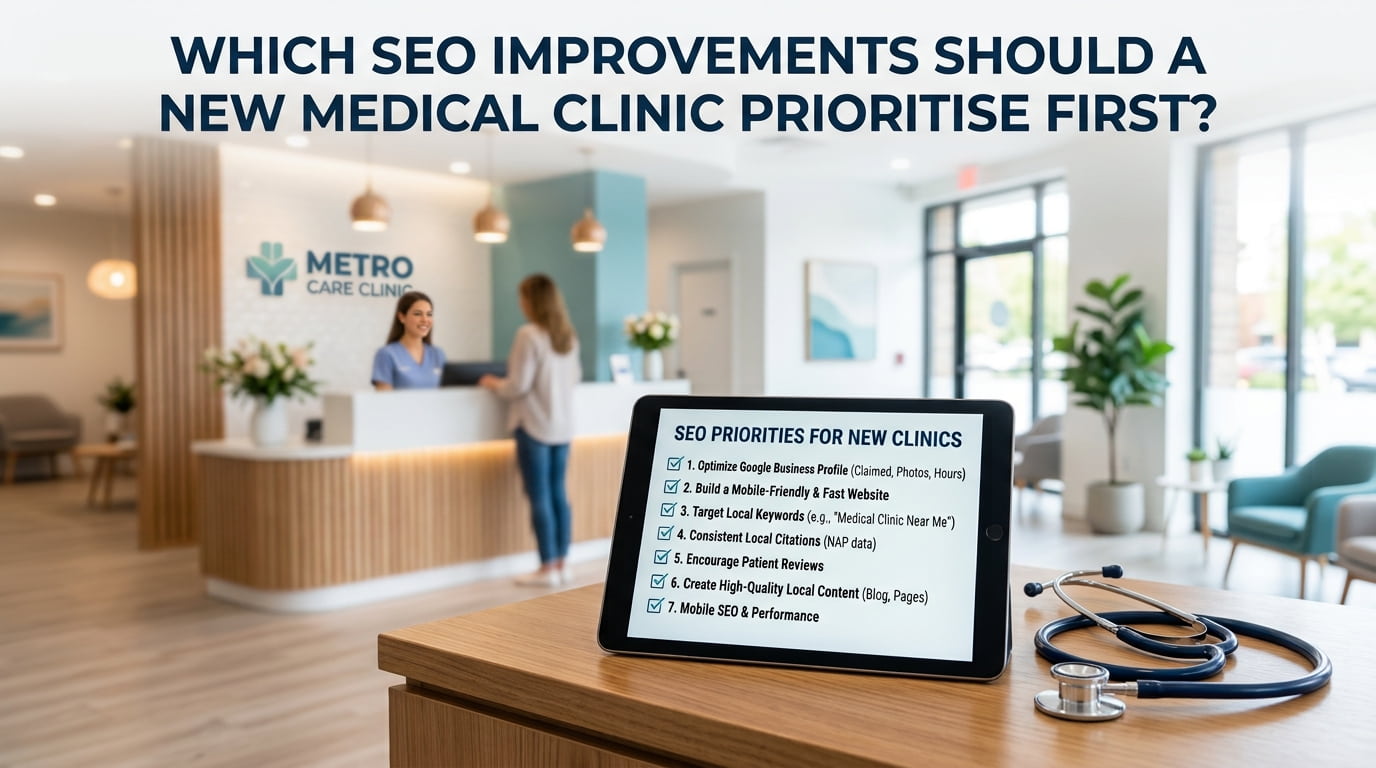
A new medical clinic should begin SEO by establishing accurate business information, creating pages for its main services, setting up local search profiles and making appointment routes easy to use.
Publishing weekly blog posts should not be the first priority.
A clinic needs a strong commercial foundation before investing heavily in informational content. Patients must be able to discover what the clinic provides, where it operates, who provides the care and how to request an appointment.
This priority framework explains how a new clinic can organise its SEO work without trying to complete everything at once.
SEO Priorities for a New Medical Clinic
The recommended order is:
- Confirm the clinic’s positioning and target patients
- Set up measurement and search tools
- Build the essential website pages
- Create individual service and treatment pages
- Establish local search visibility
- Add practitioner and trust information
- Fix technical and mobile issues
- Connect the website through internal links
- Improve appointment conversion
- Publish supporting content
- Develop relevant authority
- Review performance and expand carefully
The exact order may vary slightly, but critical technical, service and local visibility work should normally come before regular blogging.
Priority 1: Define What the Clinic Wants to Be Found For
A new clinic should not begin keyword research with a long list of medical terms.
Start with the clinic’s actual services, patient types and locations.
Document:
- The clinic’s main medical services
- Its most commercially important treatments
- The conditions it genuinely assesses or manages
- The towns, cities or areas it serves
- Whether services are private, insured or referral based
- Which practitioners provide each service
- How patients can book or enquire
- Which services are available immediately
- Which services may be added later
This creates a clear boundary for the SEO strategy.
A clinic should not optimise pages for treatments it does not provide or locations it does not genuinely serve. Search visibility only has value when it connects the right patient with an available service.
Priority 2: Set Up Search and Measurement Tools
Measurement should be configured before substantial SEO work begins.
Set up:
- Google Search Console
- Google Analytics
- Google Business Profile
- Bing Webmaster Tools
- Appointment form tracking
- Telephone click tracking
- Booking button tracking
- Confirmation page tracking
- Cookie consent where required
Test every conversion action manually.
The clinic should be able to determine:
- Which pages patients enter through
- Which search queries generate visibility
- Which services receive enquiries
- Which locations generate interest
- Whether patients call, submit a form or use a booking system
- Whether mobile visitors complete enquiries
Without measurement, the clinic may attract traffic without knowing whether it produces suitable appointment requests.
Priority 3: Build the Essential Clinic Pages
Before expanding the blog, make sure the website contains the pages patients need to evaluate the clinic.
The initial structure should normally include:
- Homepage
- Services overview
- Individual service or treatment pages
- About the clinic
- Practitioner profiles
- Clinic location and contact information
- Appointment or enquiry page
- Privacy and cookie information
- Relevant patient policies
- Frequently asked questions where useful
The website does not need hundreds of pages at launch. It needs a clear group of useful pages representing the clinic’s genuine services.
Each page should have one main purpose.
For example:
| Page type | Main purpose |
|---|---|
| Homepage | Introduce the clinic and its main services |
| Service page | Explain a specific treatment or form of care |
| Practitioner profile | Explain who provides the care |
| Location page | Explain where the patient can receive care |
| Appointment page | Help the patient take the next step |
| Patient guide | Answer a question related to a service |
This separation reduces confusion for patients and search engines.
Priority 4: Create Pages for the Most Important Services
A new clinic should prioritise its highest value and most established services.
Do not hide every treatment inside one general services page.
A dedicated page may be appropriate when a service:
- Represents a distinct patient need
- Has its own consultation or treatment process
- Has meaningful search demand
- Produces valuable enquiries
- Requires specific practitioner expertise
- Is available at a particular location
- Needs detailed suitability or preparation information
Each page should explain:
- What the service is
- Who it may be suitable for
- Which concerns it addresses
- What happens during the consultation
- Who provides the service
- Where it is available
- How patients can enquire
- Relevant limitations or suitability considerations
Start with the clinic’s core services. Additional pages can be added when the clinic has the capacity, expertise and demand to support them.
Priority 5: Establish Local Search Visibility
Most new clinics depend on patients from a defined geographic area.
Local SEO should therefore begin early.
Complete the Google Business Profile with:
- The clinic’s real business name
- The most accurate primary category
- Relevant additional categories
- Correct address
- Correct telephone number
- Accurate opening hours
- Website link
- Appointment link
- Relevant services
- Current clinic photographs
The website should display the same core contact information.
Also review important healthcare and local directories. Correct inaccurate listings and remove avoidable inconsistencies.
The clinic should not create multiple Google Business Profiles or location pages unless each represents a genuine eligible location or practitioner.
For broader help building local and organic visibility, explore our clinic SEO services.
Priority 6: Add Practitioner and Clinic Trust Signals
Patients need to understand who will provide their care and whether the clinic appears credible.
Add accurate information about:
- Practitioner names
- Professional titles
- Qualifications
- Registrations
- Medical specialties
- Clinical interests
- Treatments provided
- Clinic locations
- Professional memberships
- Languages spoken
- Appointment availability
The website should also make essential clinic information easy to find:
- Full contact details
- Clinic address
- Opening hours
- Business information
- Complaints process
- Privacy information
- Relevant regulatory details
- Clear appointment routes
Avoid unsupported descriptions such as “the best”, “leading” or “world class”.
Trust should come from accurate information, professional presentation and a clear patient journey.
For clinics led by private doctors or consultants, our SEO support for doctors connects practitioner profiles, service pages and local search visibility with clear enquiry routes.
Priority 7: Check Technical and Mobile Performance
A visually attractive clinic website may still contain technical problems that restrict visibility or prevent appointments.
Review:
- Indexing
- XML sitemap
- Robots.txt
- Canonical tags
- HTTPS
- Redirects
- Broken links
- Page speed
- Image sizes
- Mobile usability
- Server errors
- Structured data
- Booking system performance
- Form submissions
Pay particular attention to mobile devices.
A patient should be able to:
- Open the menu
- Read service information
- Tap the telephone number
- find the clinic address
- View practitioner profiles
- Complete the booking form
- Understand the confirmation message
The clinic should resolve serious technical and booking problems before investing heavily in additional content.
Priority 8: Create a Clear Internal Linking Structure
New clinic websites often contain the correct pages but fail to connect them.
Internal links should help patients move between:
- Services
- Practitioners
- Locations
- Patient guides
- Appointment information
For example:
- A patient reads a guide about a medical concern.
- The guide links to the relevant service page.
- The service page introduces the practitioner.
- The practitioner profile confirms their qualifications and location.
- The patient requests an appointment.
The homepage should link to the main services. Each service page should link to relevant practitioners and locations.
Use descriptive link text rather than vague wording such as “click here”.
Priority 9: Improve the Appointment Journey
Rankings will not generate appointments if the website makes it difficult to enquire.
Every major service page should have a visible next step.
Suitable calls to action may include:
- Request an appointment
- Book a consultation
- Call the clinic
- Ask about this treatment
- Check appointment availability
Test the complete journey from search to confirmation.
Check whether:
- The appointment button is visible
- The form works on mobile
- The telephone number is clickable
- Required fields are reasonable
- The booking system loads quickly
- Patients receive confirmation
- Enquiries reach the correct team
- Staff know how quickly they should respond
A new clinic may initially receive a small amount of traffic. Improving the enquiry journey helps it get more value from each relevant visitor.
Priority 10: Publish Supporting Content
Blogging becomes useful once the main service, practitioner and location pages are established.
Choose topics connected to the clinic’s actual services and patient questions.
Useful formats include:
- Appointment preparation guides
- Treatment suitability guides
- Process explanations
- Recovery and aftercare information
- Cost and payment explanations
- Comparison guides
- Decision frameworks
- Frequently asked questions
Each article should support a relevant service rather than exist as an isolated blog post.
Avoid publishing general health content simply because a keyword has high search volume. A new clinic should prioritise topics that help potential patients understand its services and make an informed enquiry.
Priority 11: Build Reviews, Citations and Relevant Authority
A new clinic should gradually build credible external signals.
These may include:
- Genuine patient reviews
- Professional register profiles
- Healthcare directory listings
- Local business listings
- Practitioner association profiles
- Supplier or partner links
- Relevant local coverage
- Useful expert contributions
Prioritise accuracy and relevance.
Avoid buying bulk backlinks, publishing fabricated reviews or submitting the clinic to hundreds of unrelated directories.
Authority should develop around the clinic’s real services, professionals and location.
Priority 12: Review Performance Before Expanding
A new clinic should not create additional pages simply because competitors have larger websites.
After the initial foundation is in place, review:
- Search impressions
- Organic clicks
- Service page visibility
- Local search visibility
- Appointment enquiries
- Telephone calls
- Booking completions
- Enquiry quality
- Pages receiving impressions but no clicks
- Queries appearing on the wrong pages
Use these findings to choose the next improvement.
For example:
- A service page receiving impressions but few clicks may need a clearer title.
- A page ranking for irrelevant searches may need tighter targeting.
- A treatment page receiving traffic but no enquiries may need stronger trust information.
- A location with demand but weak visibility may need better local optimisation.
- Several similar pages may need consolidation.
A 90 Day SEO Priority Framework
A new clinic can divide its early SEO work into three phases.
Days 1 to 30: Establish the Foundation
Prioritise:
- Analytics and Search Console
- Google Business Profile
- Website indexing
- Keyword mapping
- Main service pages
- Clinic contact information
- Appointment tracking
- Technical error correction
The purpose of this phase is to ensure the clinic can be found, understood and contacted.
Days 31 to 60: Strengthen Trust and Local Relevance
Prioritise:
- Practitioner profiles
- Location information
- Internal linking
- Medical content review
- Mobile improvements
- Relevant directory listings
- Review collection process
- Service page improvements
The purpose of this phase is to help patients evaluate the clinic and its practitioners.
Days 61 to 90: Expand Carefully
Prioritise:
- Supporting patient guides
- Additional service pages where justified
- Conversion improvements
- Search query analysis
- Competitor gap review
- Relevant authority building
- Performance reporting
The purpose of this phase is to expand visibility without creating unnecessary or overlapping pages.
What Should a New Clinic Avoid?
Common mistakes include:
- Publishing blogs before completing service pages
- Targeting every possible medical keyword
- Creating location pages for areas without genuine relevance
- Copying treatment descriptions from competitors
- Using the same text across several services
- Hiding practitioner information
- Creating several pages for the same search intent
- Buying low quality backlinks
- Using unsupported medical claims
- Tracking traffic without tracking appointments
- Redesigning the website without protecting existing URLs
- Expecting immediate rankings for competitive searches
A focused website with accurate service information is more useful than a large website containing thin or duplicated pages.
Final Priority Checklist
A new medical clinic should confirm that it has:
- Defined its services and target patients
- Selected its priority locations
- Set up Search Console and analytics
- Configured enquiry tracking
- Created essential clinic pages
- Built pages for its main services
- Completed its Google Business Profile
- Added accurate practitioner profiles
- Checked indexing and mobile usability
- Connected services, practitioners and locations
- Tested appointment forms
- Established a review process
- Planned supporting content
- Created a reporting schedule
SEO for new medical clinics should begin with clarity, accessibility and patient trust.
Build the pages patients need first. Make sure those pages can be found and used. Supporting content and authority development can then strengthen the foundation over time.
If your clinic needs a structured search strategy, our clinic SEO services can help improve service visibility, local rankings and patient enquiry journeys.
Frequently Asked Questions
Should a new medical clinic start blogging immediately?
Not usually. The clinic should first complete its main service pages, practitioner profiles, location information, Google Business Profile and appointment tracking. Blogging becomes more valuable after these foundations are established.
How many service pages should a new clinic create?
Create pages for established services that represent distinct patient needs. The correct number depends on the clinic’s actual offering, not the number of services listed by competitors.
Is local SEO important for a new clinic?
Yes. Most clinics need visibility among patients within a practical travelling distance. The website and Google Business Profile should clearly communicate the clinic’s location and available services.
How long does SEO take for a new medical clinic?
It depends on the website, location, competition and services. Technical and local improvements can create early progress, while competitive treatment searches may require longer and continued work.
Does a new clinic need backlinks?
Relevant links can support authority, but they should not be the first priority. Service pages, technical setup, local information, practitioner profiles and appointment tracking should normally come first.
Should a clinic target nearby towns?
Only when the clinic genuinely serves patients from those areas and can create useful information for them. Avoid publishing duplicated town pages simply to target additional locations.
You may also find useful: How Can a Medical Clinic Improve Its Local Search Visibility? · What Should a Clinic Google Business Profile Include? · What Should Happen During the First 90 Days of a Medical SEO Campaign?
Related services: SEO for Skin Clinics · SEO for Beauty Clinics · SEO for Men’s Aesthetic Clinics