

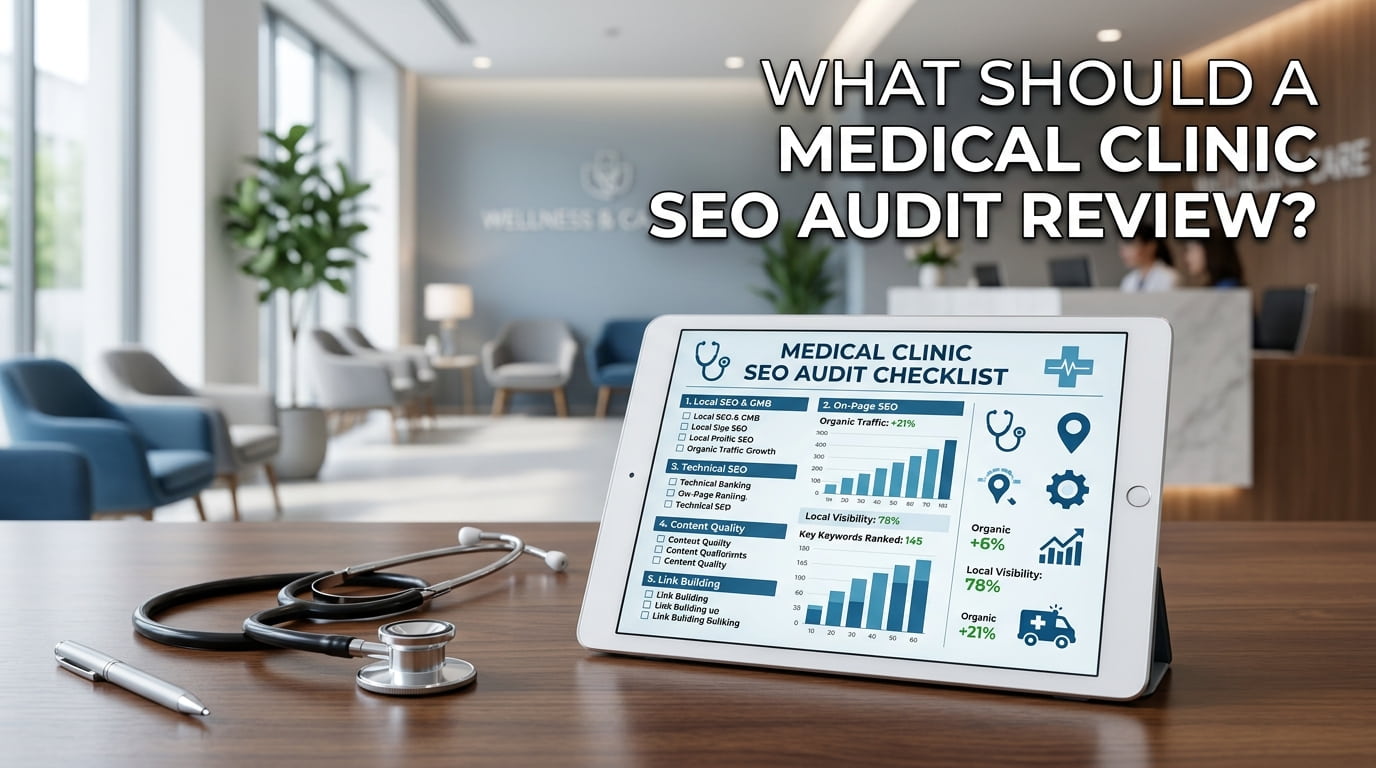
A medical clinic SEO audit should examine whether search engines can access the website, whether its pages match patient searches and whether visitors can confidently move from Google to an appointment enquiry.
The audit should cover more than rankings. It should review technical SEO, treatment pages, clinic locations, practitioner profiles, medical content, local visibility, trust signals and conversion tracking.
The objective is to identify which problems are limiting relevant patient enquiries and determine what the clinic should improve first.
Medical Clinic SEO Audit Checklist
A complete audit should review:
- Website indexing and crawlability
- Keyword targeting
- Treatment and service pages
- Clinic location pages
- Practitioner profiles
- Google Business Profile
- Medical content quality
- Internal linking
- Technical performance
- Mobile usability
- Structured data
- Reviews and external listings
- Appointment and enquiry paths
- Analytics and conversion tracking
- Competitor visibility
Each area should be evaluated according to its potential effect on patient visibility, trust and enquiries.
1. Check Whether Important Clinic Pages Are Indexed
Start by confirming that Google can access and index the clinic’s important pages.
Review:
- Homepage
- Main treatment pages
- Medical service pages
- Clinic location pages
- Doctor and practitioner profiles
- Contact and appointment pages
- Important patient guides
Use Google Search Console to inspect individual URLs and identify pages excluded from indexing.
Common problems include:
- Accidental
noindextags - Important pages blocked by robots.txt
- Incorrect canonical tags
- Broken internal links
- Redirect chains
- Pages returning server errors
- Outdated URLs remaining in the sitemap
- Duplicate versions of the same page
- Important content loaded incorrectly through JavaScript
A clinic should correct indexing problems before expanding its blog or creating more treatment pages. Publishing additional content will not solve a technical issue preventing Google from accessing the website.
2. Review the Clinic’s Keyword Targeting
Every important page should have a clear purpose and target a recognisable patient need.
Create a keyword map containing:
- Page URL
- Primary keyword
- Secondary keywords
- Patient search intent
- Target location
- Current ranking queries
- Current impressions and clicks
- Enquiry value
For example:
| Patient search | Suitable page |
|---|---|
| Private GP clinic | Main GP service page |
| Blood test clinic in Bristol | Blood testing service page |
| Dermatology clinic in Manchester | Dermatology service or location page |
| Dr Jane Smith dermatologist | Individual doctor profile |
| How much does a private blood test cost? | Service page or supporting guide |
| Medical clinic near me | Homepage, location page and Google Business Profile |
Avoid assigning the same primary keyword to several pages. If multiple URLs compete for the same search intent, Google may struggle to determine which page is most relevant.
The audit should identify whether pages need to be consolidated, differentiated or redirected.
3. Audit Every Treatment and Service Page
Treatment and service pages are usually the clinic’s most commercially important organic landing pages.
Each important service should have enough information to help a patient understand:
- What the service is
- Who it may be suitable for
- Which concerns or conditions it addresses
- What happens during the consultation
- Who provides the service
- Where the service is available
- How suitability is assessed
- Whether preparation or aftercare information is needed
- How to book or enquire
Avoid publishing a single services page containing only a short list of treatments. Important services should normally have dedicated pages when they represent distinct patient needs and have sufficient search or enquiry value.
The audit should also identify treatment pages containing:
- Thin descriptions
- Repeated wording
- Unsupported claims
- Missing practitioner information
- Unclear locations
- No internal links
- Hidden appointment options
- Outdated availability
- Excessive keyword repetition
For specialist help improving these pages, review our clinic SEO services.
4. Review Location Targeting
A clinic’s location information should be clear and consistent.
For a single location clinic, review whether the website shows:
- Complete address
- Correct telephone number
- Opening hours
- Directions
- Parking or public transport information
- Accessibility information
- Services available at the location
- Practitioners based there
- A visible appointment route
A multi location clinic may need a dedicated page for each genuine location.
Each location page should provide useful information specific to that clinic. Avoid creating several pages that repeat the same content while only changing the town or city name.
The audit should determine whether each location page serves a real patient purpose and whether it connects naturally with the relevant services and practitioners.
5. Assess Doctor and Practitioner Profiles
Patients often want to know who will provide their care before requesting an appointment.
Review whether each bookable practitioner has a useful profile containing:
- Full professional name
- Current role
- Relevant qualifications
- Professional registration
- Medical specialty
- Clinical interests
- Conditions commonly managed
- Treatments provided
- Clinic locations
- Languages spoken
- Professional memberships
- Relevant research or teaching
- Appointment information
- A current professional photograph
All information should be accurate and verifiable. Profiles should be reviewed whenever a practitioner changes role, clinic location, qualifications or service availability.
Practitioner profiles should link to the treatments they provide. Treatment pages should also identify and link to the relevant practitioners.
6. Audit the Google Business Profile
Local search visibility is particularly important for clinics serving patients within a defined geographic area.
Review whether the clinic’s Google Business Profile contains:
- The correct real world business name
- The most appropriate primary category
- Relevant additional categories
- Accurate address
- Accurate opening hours
- A working telephone number
- The correct website landing page
- Current clinic photographs
- Relevant services
- Appropriate appointment information
- Genuine patient reviews
- Professional responses to reviews
Check for duplicate profiles, outdated practitioner listings and incorrect map locations.
The information on the profile should match the website and important healthcare directories.
7. Evaluate Medical Content Quality
Medical content needs a higher level of accuracy and accountability than ordinary marketing content.
Review whether important pages:
- Clearly state the intended audience
- Explain the topic in understandable language
- Distinguish general information from personal medical advice
- Identify the relevant medical service
- Use appropriate and current terminology
- Avoid guaranteed results
- Avoid unsupported claims
- Identify an author or medical reviewer where appropriate
- Display a meaningful review or update date
- Link to suitable primary sources when needed
- Provide a clear next step
The clinic should have a content review process. New and updated medical content should be checked by an appropriately qualified person when clinical accuracy is involved.
The audit should also identify old articles that no longer reflect the clinic’s current services, staff or appointment procedures.
8. Review Internal Linking
Internal links help patients and search engines understand the relationship between services, practitioners and locations.
Check whether:
- The homepage links to the main clinical services
- Service hub pages link to individual treatments
- Treatment pages link to relevant practitioners
- Practitioner profiles link back to treatments
- Location pages link to services available there
- Medical articles link to the appropriate service page
- Breadcrumbs reflect the website structure
- Important pages are not isolated
Use descriptive anchor text that explains where the link leads.
For example, “private dermatology consultations” provides more context than “click here”.
Avoid repeatedly forcing the same keyword into every link. Anchor text should remain natural and useful.
9. Check Technical Performance
Technical problems can prevent strong medical content from performing properly.
Review:
- HTTPS implementation
- XML sitemap
- Robots.txt
- Canonical tags
- Redirects
- Broken links
- Duplicate pages
- Page loading performance
- Image sizes
- Core Web Vitals
- JavaScript rendering
- Mobile compatibility
- Server errors
- Structured data errors
- Cookie banner behaviour
- Form functionality
Large clinic images, videos and booking tools can slow pages considerably. Compress images and remove unnecessary scripts without weakening the patient experience.
A specialist medical SEO audit can help identify technical and content issues affecting important clinic pages.
10. Test the Mobile Experience
Many patients will first encounter the clinic through a mobile search.
Test whether users can:
- Read the content without zooming
- Open the navigation
- Tap the telephone number
- Find the clinic address
- View practitioner profiles
- Understand treatment information
- Use the appointment system
- Submit an enquiry form
- Manage the cookie banner
- Return to the previous page without losing information
Pay particular attention to booking tools supplied by third parties. A clinic website may load quickly while its embedded appointment system remains slow or difficult to use.
11. Review Structured Data
Structured data can help search engines understand the clinic, its practitioners and its content.
Depending on the page, relevant schema may include:
MedicalClinicMedicalOrganizationPhysicianPersonMedicalProcedureServiceArticleBreadcrumbListOrganization
The markup must match information that visitors can see on the page.
Do not add services, locations, ratings or practitioner details that are not genuinely displayed and supported.
Structured data does not replace clear page content and does not guarantee enhanced search results.
12. Check Reviews and External Listings
Review the clinic’s presence across relevant external websites.
Check:
- Healthcare directories
- Professional registers
- Local directories
- Hospital or partner websites
- Practitioner listings
- Social profiles
- Map listings
- Existing backlinks
The clinic name, address, telephone number and website should be consistent.
The audit should identify:
- Duplicate listings
- Incorrect contact details
- Outdated practitioner information
- Broken website links
- Unclaimed profiles
- Suspicious or irrelevant backlinks
Patient reviews should be genuine and obtained through an appropriate process. Do not publish invented testimonials or remove important context from patient feedback.
13. Evaluate Appointment and Enquiry Paths
SEO cannot generate appointments if visitors cannot complete the next step.
Review every major landing page and ask:
- Is the telephone number visible?
- Is there a clear appointment button?
- Does the button lead to the correct booking route?
- Does the form work on mobile?
- Are required fields reasonable?
- Does the patient receive confirmation?
- Are enquiries delivered to the correct team?
- Is the clinic’s response process clear?
- Are urgent medical situations handled with appropriate wording?
Calls to action should match the service.
Examples include:
- Request an appointment
- Book a consultation
- Call the clinic
- Ask about this treatment
- Check appointment availability
Avoid vague buttons such as “Learn more” when the visitor is already on a detailed treatment page and is ready to enquire.
14. Confirm That Enquiries Are Being Tracked
A clinic should measure more than organic traffic.
Track:
- Appointment form submissions
- Contact form submissions
- Telephone link clicks
- Calls from organic visitors
- Booking button clicks
- Email clicks
- Direction requests
- Visits to confirmation pages
- Enquiries by treatment
- Enquiries by location
Google Search Console can show which queries and pages generate impressions and clicks. Analytics and call tracking can then help connect that visibility with patient actions.
Check whether duplicate events are inflating conversion numbers. Test each conversion manually and confirm that it fires only when the intended action is completed.
15. Compare the Clinic With Relevant Search Competitors
The clinic’s search competitors may not be the same as its perceived local competitors.
Search the main service and location keywords and review which websites consistently appear.
Compare:
- Treatment page coverage
- Location relevance
- Practitioner profiles
- Internal linking
- Medical content depth
- Website usability
- Review visibility
- Google Business Profile strength
- Relevant backlinks
- Appointment experience
Do not copy a competitor’s wording or website structure. Use the comparison to identify patient questions and useful page types your clinic has not addressed.
How Should Audit Findings Be Prioritised?
Not every problem has the same commercial impact.
Fix immediately
Prioritise issues such as:
- Important pages are not indexed
- The website or booking system is unavailable
- Appointment forms do not work
- Contact details are incorrect
- Important URLs redirect incorrectly
- Mobile visitors cannot use the website
- Outdated medical or practitioner information is displayed
Address next
Then improve:
- Thin treatment pages
- Weak local targeting
- Missing practitioner profiles
- Duplicate content
- Poor internal linking
- Unclear page titles
- Slow important pages
- Missing conversion tracking
- Weak appointment calls to action
Develop over time
Ongoing work can include:
- New treatment content
- Medical article updates
- Review acquisition
- Local citations
- Relevant backlinks
- Conversion testing
- Competitor monitoring
- Search query analysis
How Often Should a Clinic Complete an SEO Audit?
A detailed clinic SEO audit should normally be completed before a major SEO campaign and after a website redesign or migration.
Technical performance, Google Search Console data, conversions and important service pages should be reviewed regularly.
A clinic should not wait for traffic to collapse before checking the website. Smaller monthly reviews can identify indexing problems, broken forms and declining pages before they cause a significant loss of enquiries.
Final Medical Clinic SEO Audit Checklist
Before completing the audit, confirm that you have reviewed:
- Indexing and crawlability
- Keyword mapping
- Treatment pages
- Clinic locations
- Practitioner profiles
- Medical content accuracy
- Internal links
- Google Business Profile
- Mobile usability
- Website speed
- Structured data
- Reviews and citations
- Backlinks
- Appointment journeys
- Conversion tracking
- Search competitors
- Prioritised recommendations
A medical clinic SEO audit should finish with a clear action plan, not simply a list of errors.
Each recommendation should explain what needs to change, why it matters and which page or patient journey it affects.
Clinics that need help improving treatment visibility, local rankings and patient enquiry journeys can explore our clinic SEO services.
Frequently Asked Questions
What is a medical clinic SEO audit?
A medical clinic SEO audit is a structured review of the technical, content, local search and conversion factors affecting a clinic website’s organic visibility and patient enquiries.
How long does a clinic SEO audit take?
The timeframe depends on the website’s size, number of locations, number of practitioners and technical complexity. A small clinic website may require a focused review, while a multi location provider may need a detailed audit covering hundreds of pages.
Should an SEO audit include the Google Business Profile?
Yes. Most clinics depend partly on local patient demand. The audit should review the clinic’s website and Google Business Profile together.
Does every treatment require a separate page?
No. A separate page is appropriate when the treatment represents a distinct patient need and has enough information, search demand or enquiry value. Closely related treatments may sometimes be better presented together.
Should practitioner profiles be included in the audit?
Yes. Practitioner profiles support patient trust and help connect doctors or clinicians with relevant treatments and clinic locations.
What should happen after the audit?
The clinic should convert the findings into a prioritised implementation plan. Critical technical and enquiry problems should be fixed first, followed by service page, local SEO and content improvements.
You may also find useful: What Should a Clinic Check Before Migrating or Redesigning Its Website? · How Can a Medical Clinic Improve Its Local Search Visibility? · How Can a Clinic Assess Whether an SEO Recommendation Is Clinically Safe and Search-Useful?
Related services: SEO for Dentists · SEO for Veterinary Clinics